Why Some Booths Get Remembered展位凭什么被记住
A single edition of the Hong Kong International Jewellery Show brings around 4,000 exhibitors and close to 80,000 buyers from some 150 countries and regions. That is the denominator you are working against: a buyer walks past several hundred booths in three days, and the window you get may be a few seconds long. Your booth, your display props and your packaging are the people speaking on your behalf inside those seconds.
Q1. Traffic is huge, so why does nobody stop at my booth?
Start with the arithmetic. Booth traffic is usually estimated as total attendance multiplied by the share of attendees who pass your aisle, multiplied by your stop rate. A 10x10 inline booth typically sits in the path of roughly 3%-5% of total attendance; a 10x20 inline reaches 5%-8%; a 20x20 island 8%-12%. Position matters just as much: corner and near-entrance positions commonly see two to three times the passing traffic of a mid-aisle stand.
Industry average stop rate is 10%-20%. Booths with a demonstration, a clear focal point and something genuinely worth looking at reach 30%-50%. Run the numbers on 80,000 buyers, a 3% pass rate and a 12% stop rate and you get roughly 288 people. Lift the stop rate from 12% to 25% and you double that number without paying a cent more for the space.
Why do people walk on? Because visitors decide to stop or keep moving in about eight seconds. Very little information survives that window: the direction your booth opens, whether the sightline is clear, one mark legible from five metres away, and one or two pieces striking enough to interrupt a walk. Open layouts typically draw around 40% more foot traffic than enclosed ones. So keep cartons and literature out of the opening, and push the meeting table to the inside instead of blocking your own door.
Q2. How should the goods actually be laid out so buyers look closely?
Three things, in order: height, zoning, negative space.
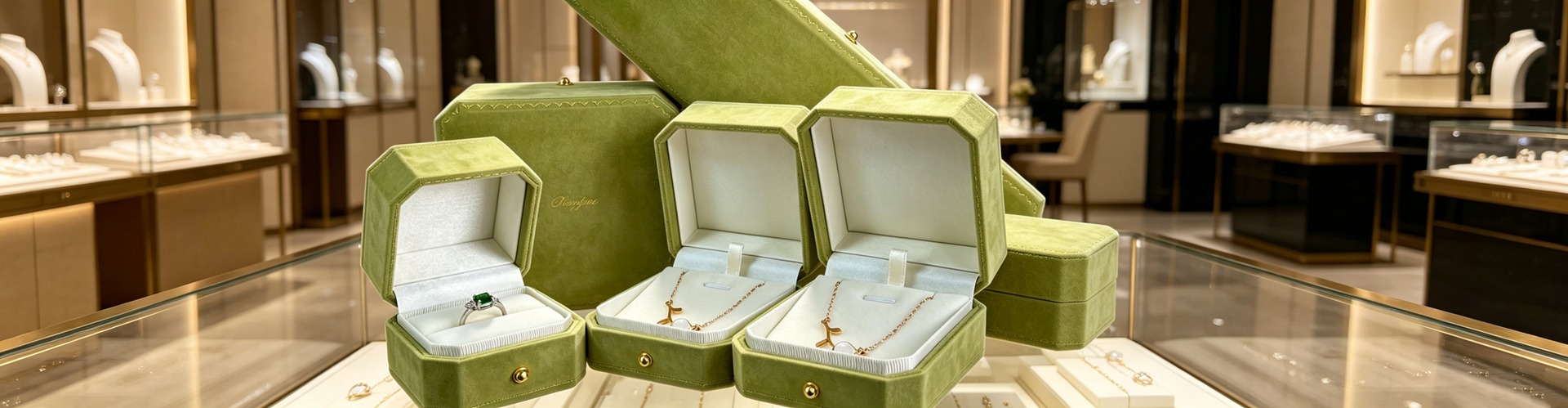
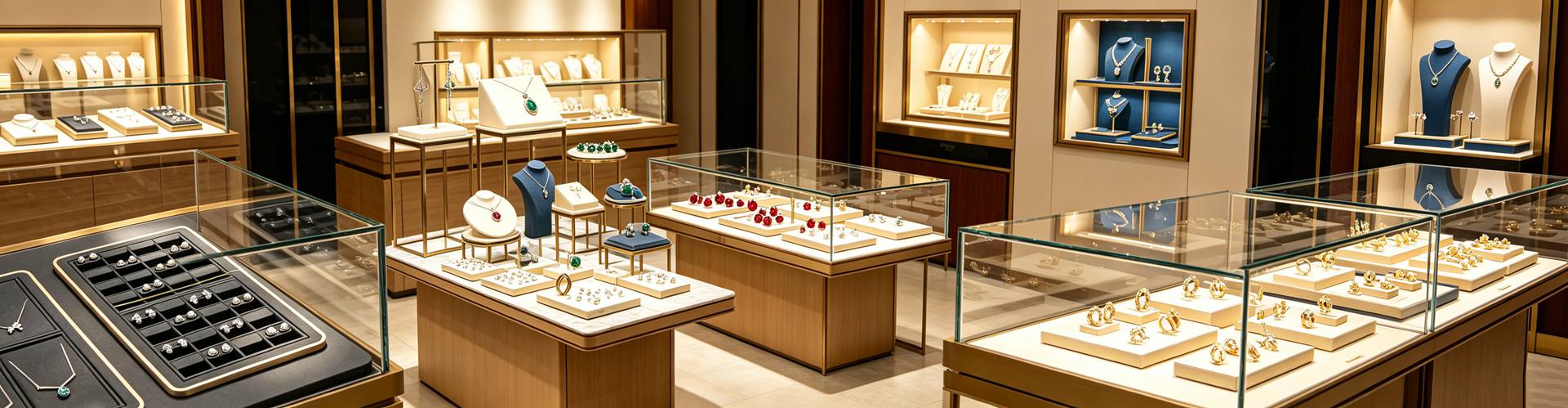
Height. Eye level, roughly 1.2-1.6 metres, is the golden band; hero pieces belong there. Catalogues and small samples go low, brand imagery goes high. Zoning. The front row facing the aisle carries new arrivals and best sellers and does the job of stopping people. The middle carries your core collection and does the job of holding them. Bulky props and backdrops go against the inner wall. Negative space. Overfilling is the most common mistake. A packed table asks the buyer to do the editing, and most buyers will not bother.
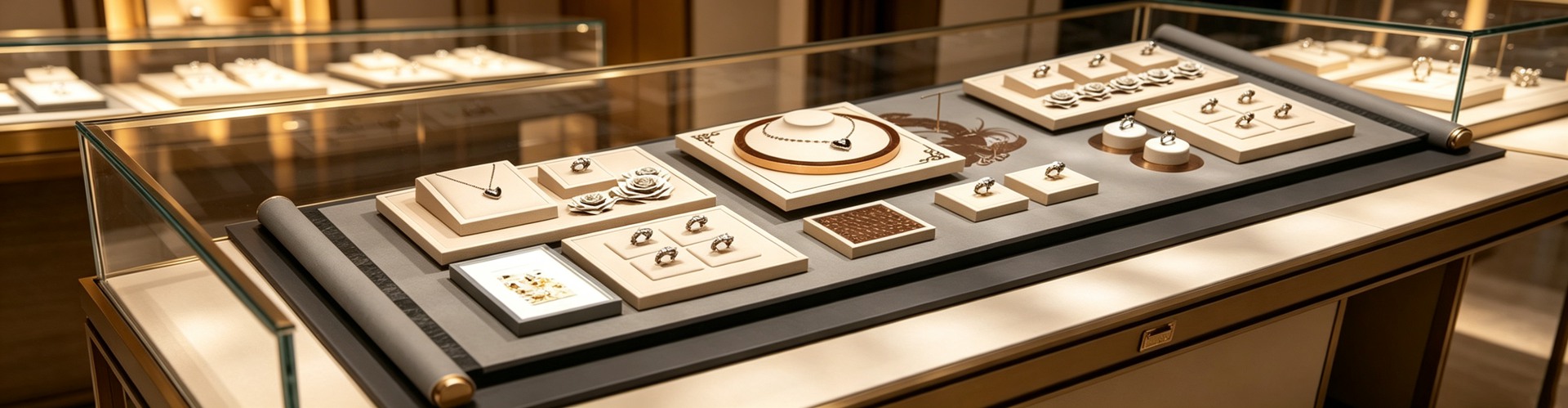
When space runs short, build upward rather than cramming inward. Stepped shelving that rises from front to back keeps sightlines open, a one-square-metre rotating island can hold twenty pieces comfortably, and magnetic wall trays let you change heights on the fly. The props themselves matter too: acrylic needs 8-10mm thickness before it stops reading as cheap, velvet, suede and microfibre contact surfaces reduce scratching, and a matte dark base with a thin metal edge is the safest premium combination. Keep mirrors, a try-on position and a loupe within reach. Trade buyers are assessing not only the goods but whether you can explain them.
Q3. The hall lighting is not mine to control. What should I bring?
Hall ambient lighting is usually a few hundred lux, mixed in colour temperature and uncontrolled in direction. It is light that lets you see, not light that makes you want. Three rules: bring your own track spots for the hero positions, using around 3000K warm light for gold and coloured stones and around 4000K neutral light for diamonds and platinum; insist on a colour rendering index of at least 90Ra, or your coloured stones will look grey on your own stand; and angle in-case strips at about 45 degrees to keep glare out of the buyer's eyes.
One detail almost everyone misses: the brighter the prop, the harder it competes with the jewellery. Under accent lighting, high-gloss lacquer and mirror acrylic turn into actual mirrors reflecting the aisle and the ceiling. The more matte the surface of a display stand, the brighter the piece sitting on it appears.
Q4. Will minimal, high-end packaging look too plain on a show floor?
The opposite is true. A trade show is where restraint pays off most, though for different reasons than in a store.
Five-metre legibility. An exhibition hall is visually saturated; hundreds of booths are shouting at once. At five metres the human eye processes shape, colour block and contrast, not the density of a foil pattern. Complex decoration is craft in the hand and noise at a distance.
The light is not yours. With mixed colour temperatures and unpredictable angles, large foil areas and glossy lamination blow out into flat white patches, while a solid matte surface holds its shape under any light.
Memory encoding. A buyer sees hundreds of suppliers in three days. Back at the hotel, sorting business cards, what survives is "the dark green square box," not a particular flourish. Only a visual that can be repeated in one sentence makes the next morning's shortlist. Minimal is not less information; it is information compressed into something repeatable.
There is also an inverse argument. Minimal design leaves nowhere to hide. Thirty seconds in the hand tells a buyer whether the folds are square, whether the closure feels settled, whether the insert fits. Ornate boxes bury those questions under decoration; a plain box hands every tolerance back to the structure. Putting minimal packaging on a show floor is therefore a public demonstration of your quality control. Roughly 81% of trade show attendees hold purchasing authority and about 72% say exhibitions influence their buying decisions. The precision you show on the stand is read as the precision of your production line.
Q5. How do the samples and props survive shipping and three days on the floor?
Choose modular first. Knock-down stands cut build time noticeably, which compounds for brands doing several shows a year. Props need packaging of their own: edges, surfaces and cantilevered elements take the damage in transit, and velvet or suede crushes permanently, so nothing should be stacked without separation. Pack sample cases in order of use rather than by volume. You will open them dozens of times in three days, and not finding a piece is worse than not having it.
Environment gets forgotten. Keep booth humidity in the 50%-60% range; too dry and pearls and organic gems lose moisture. Avoid direct sunlight and prolonged hot spots, which fade coloured stones. On security: lock the cases, accompany every try-on of high-value pieces, keep cotton gloves on hand, and count out by category rather than by total when you pack down. Worth noting that the Hong Kong show runs a dedicated jewellery display and packaging section. In this industry, props and packaging are procured as a category in their own right.
Q6. Where is the show actually won or lost?
Here is an uncomfortable figure: a 2026 study covering twenty major US trade shows found that roughly 80% of show leads are never followed up at all.
Speed decides the rest. The Lead Response Management study, run with MIT researchers across more than 15,000 leads, found that contacting a lead within five minutes made it about 21 times more likely to qualify than contacting it at thirty minutes. Harvard Business Review's analysis of 2.24 million sales leads found firms responding within an hour were nearly seven times more likely to qualify a lead. After 48 hours, the likelihood of making contact drops by roughly ten times. Teams using three channels, email, phone and SMS, convert around 30% better than single-channel teams.
The economics are worth stating. Global average cost per trade show lead sits around 112 US dollars, with 150-350 dollars common at major B2B events; lead-to-opportunity conversion benchmarks at 15%-25%; and a 4:1 return is widely treated as the pass mark. On those numbers, a lead left in a card holder is cash thrown away.
Which brings us back to packaging. When the show ends, the booth comes down and the props go into crates. The only thing still speaking for you in the buyer's office is the sample box he carried out. It decides whether, two weeks later, his memory of you is sharp or vague.
A booth competes for eight seconds. A box competes for the weeks after the flight home. What is genuinely scarce at a trade show is never floor space. It is a way of being remembered.
This is original content. Copyright belongs to Shenzhen Junyimei.
Junyimei - present every jewel and timepiece at its best.
香港国际珠宝展一届开下来,双展约4,000家参展商、来自约150个国家及地区的近80,000名买家。分母就摆在这里:一位买家三天要走完几百个展位,留给你的时间可能只有几秒钟。展位、道具、包装,就是在这几秒里替你说话的人。
问一:人流明明很大,为什么就是没人在我展位前停下来?
先把账算清楚。展位到访人数有一个通行的估算公式:总观众数 × 途经比例 × 停步率。10×10 的标准展位,途经比例大约是总人流的 3%–5%;10×20 的长条位约 5%–8%;20×20 的岛型位约 8%–12%。位置系数同样关键,靠近入口和端头的角位,途经人数通常是中段位的 2–3 倍。
停步率的行业均值是 10%–20%,而有演示、有互动、有清晰焦点的优秀展台可以做到 30%–50%。按 8 万买家、途经 3%、停步 12% 算,大约 288 人会停下来;如果把停步率从 12% 提到 25%,人数直接翻倍,而你的摊位费一分没多花。
为什么停不下来?因为参观者大约在 8 秒内就决定了停还是走。这 8 秒能被处理的信息很少:展位开口的朝向、视线是否通透、一个五米外能认出的标识、以及一两件够抢眼的主推。开放式布局的展位,进位人流通常比封闭式高出约 40%。所以开口不要堆纸箱和宣传物料,洽谈桌椅往内侧放,别把自己的门堵上。
问二:展品到底怎么摆,买家才愿意细看?
按三件事排:高度、分区、留白。
高度:平视的 1.2–1.6 米是黄金带,主推款放这里;低处放册子和小件样品,高处留给品牌视觉。分区:靠过道的前排放新款和爆款,任务是"拦人";中段放主营系列,任务是"留人";大件和背景物料靠内侧墙面。留白:摆满是最常见的错误,密密麻麻等于让买家自己做减法,多数人不做,直接走开。
空间不够时,向上要比向里塞划算:阶梯式层板前低后高不挡视线;一平米的旋转中岛可以稳稳陈列 20 件;墙面磁吸托盘能随时改高度、换组合。道具本身也讲究——亚克力厚度做到 8–10 毫米才不显廉价,绒面、麂皮、超细纤维接触面能减少刮痕,哑光深色底板配一点金属收边最讨巧。镜子、试戴位和放大镜也别漏,B 端买家看的不只是货。首饰展台在展会上的任务不是好看,是把注意力按顺序交出去:拦人、留人、上手。
问三:展馆的灯不归我管,自带的灯该怎么补?
展馆的通用照明通常只有几百勒克斯,色温混杂、角度不受控,那是"能看见"的光,不是"看得心动"的光。补光有三条硬规矩:自带轨道射灯打主推位,黄金和彩宝用 3000K 暖光,钻石铂金用 4000K 中性光;显色指数至少 90Ra,否则彩宝在你展位上就是灰的;柜内灯带走 45 度角,避免直射眩光。
一个容易被忽略的点:道具越亮,越会跟珠宝抢光。在重点照明下,高亮烤漆和镜面亚克力会变成镜子,照出的是过道和顶棚。珠宝展示架的表面越哑,珠宝就越亮。
问四:高端简约的包装和道具放到展会上,会不会太素、压不住场?
恰恰相反。展会是简约最占便宜的场景,但理由和门店里不一样。
五米辨识。展会是视觉噪音饱和的地方,两侧几百个展位同时在喊。人在五米外能处理的只有形状、色块和明暗,处理不了烫金的花纹密度。复杂设计在手上是工艺,在五米外是一团糊。
光不由你。展馆色温混杂、角度不定,大面积烫金和高亮覆膜会随机反光成一片死白,而纯色哑面在任何光下都保持形状。
记忆编码。买家三天看几百家,回酒店整理名片时脑子里存下来的是"那个墨绿色的方盒子",不是某一处花纹。能被一句话复述的视觉,才进得了第二天的短名单。简约不是少给信息,是把信息压缩成一句能被转述的话。
还有反过来的一层:简约没有地方遮丑。买家上手三十秒就能摸出折边正不正、开合手感稳不稳、内衬贴不贴合。花哨的盒子靠装饰把这些盖过去,纯色盒子把全部容错交给结构本身。所以敢在展会上放简约包装,本身就是一次品控能力的公开演示。约 81% 的展会观众具备采购决策权,约 72% 表示展会影响他们的采购决策——你在展位上呈现的精度,会被直接读成量产的精度。
问五:样品和道具怎么运过去、怎么撑过三天?
优先选模块化。可拆装的展架能明显压缩搭建时间,一年跑几场展的品牌尤其划算。道具本身也需要被包装:展架的边角、表面和悬挑结构最容易在运输中受伤,绒面和麂皮怕压印,必须独立分隔、不能叠压。样品箱按"取用顺序"分层,别按体积硬塞——三天里你要开合几十次,找不到货比没有货更伤。
环境这一项常被漏掉:展位内湿度尽量控制在 50%–60%,太干珍珠和有机宝石会失水;避免阳光直射和长时间聚光,彩宝会褪色。安全上,展柜加锁、贵重件试戴需人员陪同、备一次性手套,离场清点按品类而不是按总数。顺带一提,香港国际珠宝展本身就设有"珠宝陈列及包装用品"展区——在这个行业里,道具和包装是被当作独立品类来采购的,深圳骏依美这类工厂的客户,很多就是从展会现场谈起来的。
问六:展会结束,真正的胜负在哪一段?
一个刺眼的数字:2026 年一份覆盖 20 个美国大型展会的调研显示,约 80% 的展会线索最终无人跟进。
速度决定一切。MIT 研究者参与的线索响应研究覆盖 1.5 万余条线索:5 分钟内联系,线索合格概率约为 30 分钟后联系的 21 倍;《哈佛商业评论》分析 224 万条销售线索发现,1 小时内联系的合格概率接近拖过 1 小时的 7 倍;超过 48 小时,接通概率下降约 10 倍。用邮件、电话、短信三条渠道跟进的团队,转化率比只用一条渠道高约 30%。
成本上也值得算一笔:展会线索的单条成本全球均值约 112 美元,大型 B2B 展常见区间是 150–350 美元;线索到商机的转化基准约 15%–25%;行业普遍把 4:1 的投入产出比当作及格线。
这也解释了包装在展会上的第二重价值:展会一结束,展位拆了,珠宝陈列道具装箱运走了,唯一还留在买家办公室里替你说话的,就是他带走的那只样品盒。它决定了两周后对方想起你时,记忆是清晰还是模糊。
展位争的是八秒,盒子争的是回程之后的那几周。展会上真正稀缺的从来不是位置和面积,而是被记住的方式。
本文为原创内容,版权归深圳骏依美所有,转载请注明出处。
骏依美——让每一件珠宝与腕表,都被更好地呈现。