Why Guochao Gold Is Winning China's Youth国潮黄金正当红
Gold has rarely looked this cool. As international bullion prices climbed to repeated record highs through 2026, the conventional wisdom was that younger buyers would step back. Instead, the opposite happened: China's twenty-somethings leaned in. Store counters are now filled with Gen-Z shoppers weighing bangles; social feeds overflow with "gold-bean savings challenges" and "new-Chinese-style stacking" reels racking up millions of views. Gold is shedding its old identity as a locked-away asset for the older generation and becoming, for a new cohort, a wearable emblem of taste and cultural confidence. The shift has a name in the trade: the rise of Guochao gold.
The numbers behind the hype are startling. According to Frost & Sullivan and Sinolink Securities, China's heritage-method (gufa) gold jewelry market expanded from RMB 13 billion in 2018 to RMB 157.3 billion by 2023—more than an elevenfold jump in five years, at a compound annual growth rate of 64.6%. Penetration rose from roughly 6% of the fine-gold category in 2018 to about 41% in 2023. Zheshang Securities projects the segment will surpass RMB 421.4 billion by 2028. At a moment when high gold prices are flattening overall industry growth, heritage gold is almost the only sub-category still sprinting ahead.
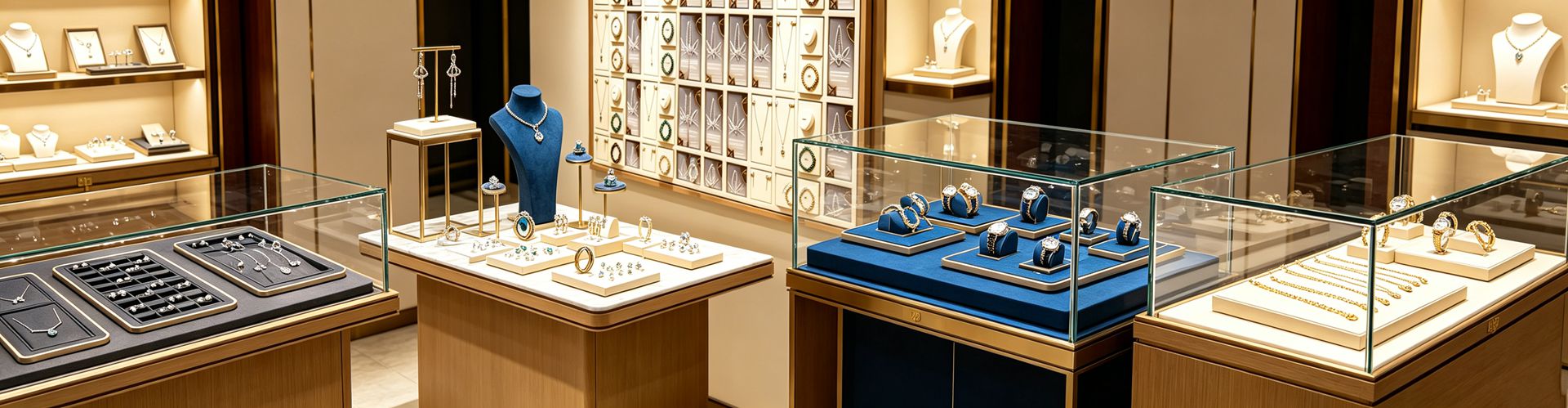
Why has heritage gold outrun the broader market? The answer lies in a double dividend of craft and culture. Unlike polished modern gold, heritage gold is produced through traditional Chinese casting, hand-chasing, hammering and filigree techniques, yielding a matte, warm, substantial "court-style" finish. Where shoppers once paid for gram-weight alone, a growing share now pay a premium for craftsmanship and cultural meaning—the logic shifting from "priced by the gram" to "fixed price plus craft and cultural premium." As 3D hard gold and 5G gold push the plasticity and hardness of pure gold to new levels, gold has finally escaped the stereotypes of being soft, easily deformed and visually dated.
Beneath the product, a deeper reversal is underway in consumer logic. China's jewelry market reached roughly RMB 835 billion in 2026, up only 4.5% year on year, yet the mix is being rewritten: wedding demand is softening while "reward-yourself" spending surges. Young buyers no longer purchase gold for the ritual of "three golds and five golds"; they buy to please themselves—a plain band for the commute, a thin chain for weekend layering, a small gold bean as a Spring-Festival treat. Lightweight, low-gram-weight, quietly-luxury formats are the new mainstream; related sales spiked as much as 214% year on year during the holiday season. Gold's occasions have spread from weddings and gifting to daily wear, the workplace and self-reward.
The brand side tells the same story with even sharper contrast. Laopu Gold, built on refined aesthetics and scarcity positioning, has carved out a premium path with a gross margin of 41.9% and a net margin of 13.1%, far ahead of the industry. It proves a simple point: in the Guochao context, a gold brand's core competence is no longer "whose gold is purer" but "who tells culture better, designs smarter and builds more taste." Gen-Z and millennials prize design, individuality and social value; 73% of post-90s consumers will even pay a 10% premium for sustainable jewelry. Once gold becomes a wearable cultural statement, brand narrative turns into invisible pricing power.
The real engine of this youth tilt is, above all, social commerce. On Douyin and Xiaohongshu, "gold-bean saving" turned accumulation into a gamified ritual: young consumers buy a one-gram bean every payday, filling a tiny jar as a gentle protest against economic anxiety and a softer alternative to speculative investing. Livestream ateliers demystified pricing and craft, letting first-time buyers ask about fineness, premiums and buyback in real time. The result is a category that feels less like a stuffy asset class and more like a community—where unboxing a new bangle is content, and wearing it is quiet self-expression.
Behind the sheen is a craft story worth telling. Heritage gold's signature matte surface comes not from polishing but from sandblasting and hand-finishing; its patterns from filigree so fine it resembles woven hair, and from champleve or cloisonne enamel that adds colour without glare. The cluster that makes much of this possible is Shenzhen's Shuibei—the country's largest gold-jewelry sourcing hub—where design studios, refiners and finishing workshops sit within a few square kilometres, compressing lead times from months to weeks. That density is why a trend born on a livestream can reach a store shelf before the season ends, and why presentation standards keep rising: in a market this fast, the box and the display are part of the product's speed-to-desire.
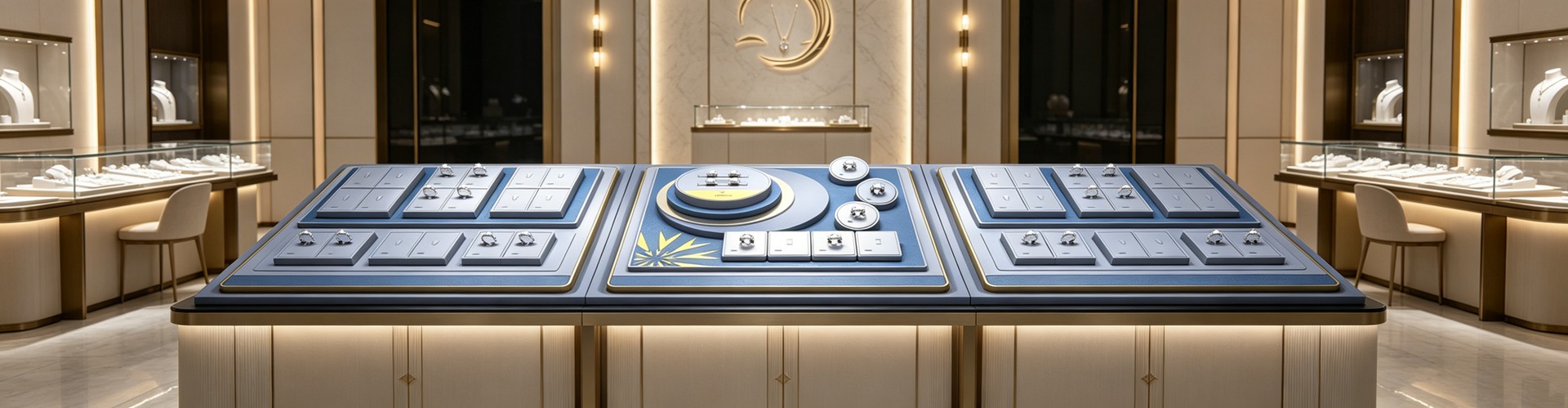
What is easy to miss is how the Guochao gold boom is quietly reshaping "presentation" itself. A matte, hand-chased heritage bangle tossed onto a cold, white-lit acrylic tray loses half its character; it needs low color temperature, soft light and a textured backing to read as warm and composed. This is exactly where jewelry display props earn their keep—good merchandising does not merely place a product, it speaks the product's cultural language. More stores are turning to wooden, velvet and rice-paper-textured jewelry display props within new-Chinese-style interiors, so the Oriental aesthetic of gold is legible at a glance. On the delivery side, jewelry packaging and the jewelry box are upgrading in step: away from uniform glossy cartons toward more restrained, tactile materials and structures, making unboxing an extension of the Guochao experience. Shenzhen Junyimei, which has long focused on jewelry packaging design and custom jewelry boxes, reads the signal clearly—when the product itself grows more refined, the box and the display that carry it must deserve the same refinement.
Gold's liquidity also feeds the loop. Unlike many fashion purchases, heritage gold holds a transparent spot price and a deep trade-in network; wearers rotate pieces as taste shifts, treating bangles as a wardrobe that can be partially "cashed back." Brands encourage this with buyback and redesign services, blurring the line between jewellery and a low-yield savings account you can wear. For a generation priced out of property and wary of volatile markets, a wearable, beautiful, partially liquid object hits a rare sweet spot—which is precisely why the trend has proved stickier than a mere aesthetic fad.
There is even a cross-border dimension. As Chinese cultural confidence travels, heritage gold is finding fans among overseas Chinese communities and, increasingly, curious international buyers drawn to its unmistakably Eastern silhouette. At trade fairs from Hong Kong to Bangkok, gufa pieces now sit beside Western fine jewellery as a distinct aesthetic language—proof that "Guochao" is less a domestic marketing tag than a genuine design movement with export legs.
For all its momentum, heritage gold is also rewriting how jewellery is styled. The old rule—gold for banquets, diamonds for everyday—has inverted. A matte bangle now anchors a minimalist office look; a filigree pendant layers over a crisp white shirt; a thin chain disappears under a collar. This "new-Chinese-style" pairing treats gold as a neutral, not a statement of occasion, which is exactly why daily-wear volumes keep climbing. Retailers respond with modular collections and mix-and-match sets, training the eye to see gold as wardrobe infrastructure rather than a once-a-year purchase. The more seamlessly it lives in a routine, the less discretionary it feels—and the more durable the demand underneath the hype.
None of this means gold has stopped being money. The spot price still anchors every conversation, and a rising tide of first-time buyers is as much about store-of-value as self-expression. The novelty is that the two motives now travel together in the same object, worn on the same wrist—a quiet fusion of identity and insurance that previous generations kept in separate drawers. Read together, the signals point less to a fad than to a structural realignment: gold repositioned from reserve to repertoire, from inheritance to identity, from the vault to the wrist.
One quiet driver worth naming is design talent. A new generation of Chinese jewelry designers, many trained abroad and now returned home, is treating heritage gold as a canvas rather than a commodity—pairing ancient techniques with contemporary silhouettes and collaborating with illustrators, archivists and even video-game IP. Their limited drops sell out in minutes, proving that cultural credibility, not just gold content, is what younger buyers queue for. In a category long defined by gram-weight, that is a small revolution of its own.
Still, heat brings hazards. Heritage gold carries high craft barriers and opaque labor fees; the market is not short of small workshops substituting K-gold, plating fakes or simplifying techniques to cut cost. Record gold prices also suppress some investment-led demand. For consumers, checking the 999 fine-gold mark, the craftsmanship and the after-sales terms matters more than chasing momentum. For brands and retailers, the real moat remains sustained design innovation and trusted quality—not a passing wave of traffic.
Return to that opening scene: a twenty-something woman carefully choosing a hand-chased little gold bangle at the counter. She is not buying a safe-haven asset; she is buying an everyday adornment that carries a cultural story she can tell. The Guochao gold narrative has only just written its prologue—as craft, culture and young purchasing power keep resonating, this particular gold story may run longer than any of us expect.
This is original content. Copyright belongs to Shenzhen Junyimei.
Junyimei — present every jewel and timepiece at its best.
当国际金价在 2026 年一路刷新历史高位,一个耐人寻味的现象同时发生:买金的人不仅没减少,主力反而换成了二十多岁的年轻人。柜台前挑选手镯的多是 95 后,社交平台上“攒金豆”“新中式叠戴”的内容动辄百万播放。黄金,正在摆脱“长辈的保险柜资产”这一旧标签,成为一代人表达审美与文化认同的随身符号。这场静悄悄的转向,业内称之为——国潮黄金的崛起。
支撑这股热潮的,是古法金品类的爆发式增长。据弗若斯特沙利文与国金证券数据,中国古法黄金珠宝市场规模从 2018 年的 130 亿元,一路攀升至 2023 年的 1573 亿元,五年增长超过 11 倍,年复合增速高达 64.6%;渗透率由 2018 年的约 6% 提升到 2023 年的约 41%。浙商证券进一步预测,到 2028 年这一规模将突破 4214 亿元。在金价高企、行业整体增速放缓的背景下,古法金几乎是唯一逆势狂奔的细分赛道。
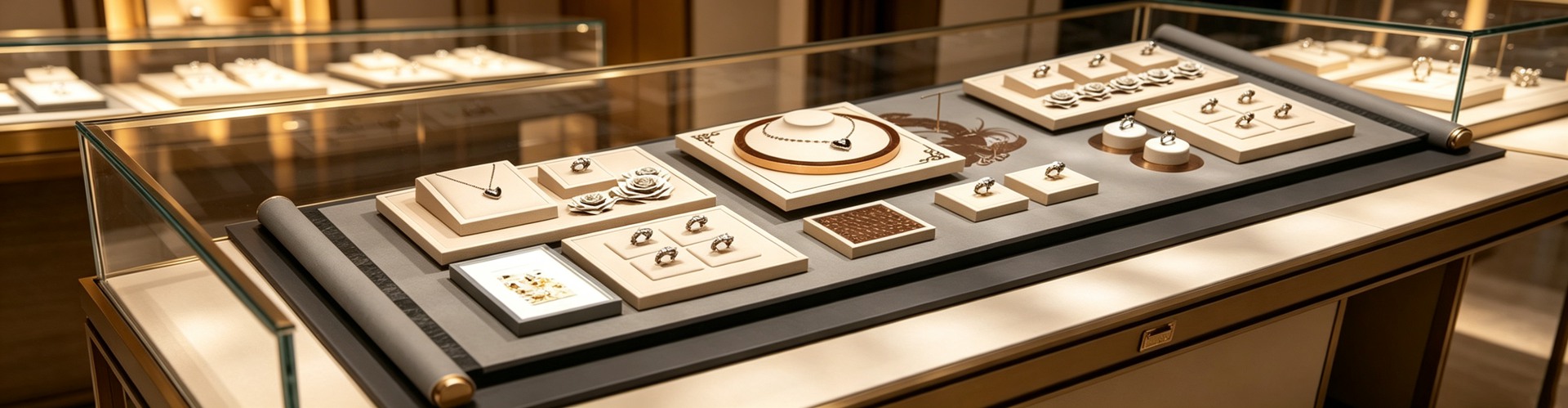
古法金为何能跑赢大盘?答案藏在“工艺”与“文化”的双重红利里。与传统光面黄金不同,古法金采用中国传统古法浇铸、手工錾刻、锤揲、花丝等工艺,呈现出哑光温润、厚实复古的宫廷质感。过去消费者为“克重”买单,如今越来越多人愿意为一份工艺与文化内涵支付溢价——产品逻辑从“按克卖”转向“一口价 + 工艺/文化溢价”。当 3D 硬金、5G 金不断刷新足金的可塑性与硬度,黄金终于摆脱了“软、易变形、设计老气”的刻板印象。
更深层的变化,是消费逻辑的彻底逆转。2026 年中国珠宝市场约 8350 亿元,同比仅增 4.5%,但结构正在洗牌:婚庆刚需走弱,悦己消费崛起。年轻人买金不再为了“三金五金”的仪式,而是为了取悦自己——职场通勤的一枚素圈、周末叠戴的一条细链、春节犒劳自己的小金豆,轻量化、低克重、轻奢化成为新主流,春节期间相关销量一度同比大涨 214%。黄金的消费场景,从婚嫁送礼,扩散到日常、职场与自我奖励。
品牌端的变化同样剧烈。以老铺黄金为代表,凭借卓越审美与稀缺定位,走出一条高端化路线:毛利率 41.9%、净利率 13.1%,大幅领跑行业。它证明了一件事——在国潮语境下,黄金品牌的核心竞争力不再是“谁的金更纯”,而是“谁更会讲文化、更懂设计、更能营造格调”。Z 世代与千禧一代重设计、重个性、重社交价值,73% 的 90 后甚至愿意为环保珠宝多付 10% 溢价。当黄金变成“可穿戴的文化表达”,品牌叙事就成了定价的隐形砝码。
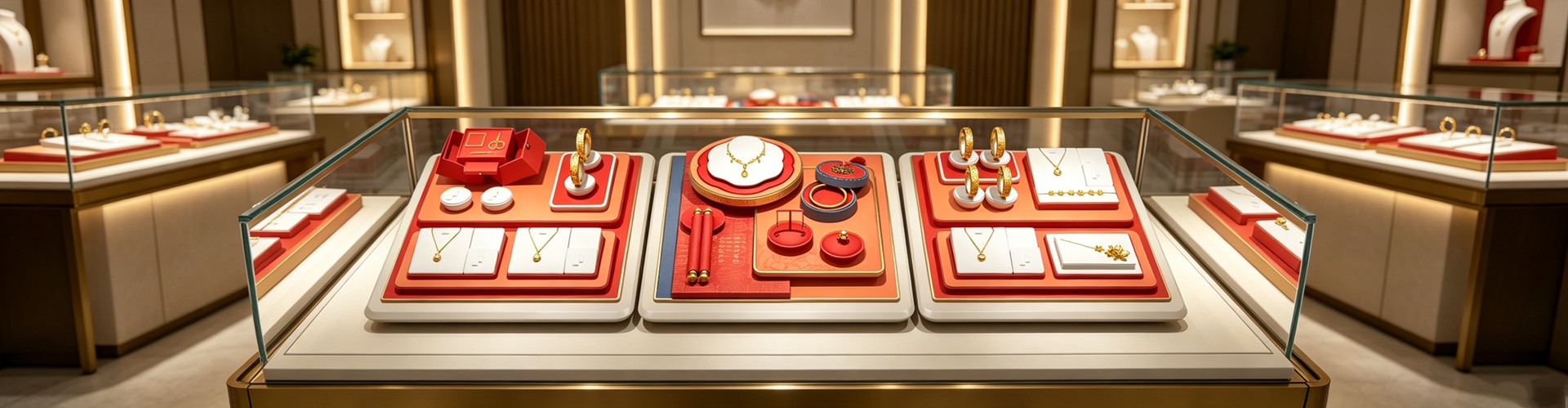
值得关注的是,国潮金饰的走红,也在重塑“呈现”这件事。一件哑光錾刻的古法金镯,若随意丢在冷白光的亚克力托盘里,质感会被白白浪费;它需要在低色温、柔光、带肌理的衬底上,才显得出温润与分寸。这恰恰是珠宝陈列道具的价值所在——好的陈列不只是摆出来,而是替产品把“文化感”说出来。越来越多门店开始用木质、丝绒、宣纸肌理的珠宝陈列道具,配合新中式空间,让黄金的东方美学被一眼读懂。而在交付环节,珠宝包装与首饰盒也同步升级:从千篇一律的亮面纸盒,转向更克制、更有手感的材质与结构,让“拆封”成为国潮体验的延伸。深圳骏依美长期专注于这类珠宝包装设计与首饰盒的定制研发,正是看准了——当产品本身越来越讲究,承载它的盒子与陈列,也必须配得上这份讲究。
当然,热潮之下并非没有隐忧。古法金工艺门槛高、工费不透明,市场上不乏以 K 金充数、镀金仿制、简化工艺压缩成本的小作坊;金价高位运行也在抑制部分投资型需求。对消费者而言,认准足金 999 标识、查看工艺与售后,比盲目追涨更稳妥。对品牌与零售端而言,真正的护城河,仍在于持续的设计创新与可信的品质,而非一时的流量。
回到开头那个画面:二十多岁的女孩,在柜台前认真挑选手工錾刻的小金镯。她买的不是避险资产,而是一件能天天佩戴、能讲出文化故事的悦己之物。国潮黄金的叙事,才刚刚写开场白——当工艺、文化与年轻消费力持续共振,黄金这个故事,或许会比我们想象中讲得更久。
本文为原创内容,版权归深圳骏依美所有,转载请注明出处。
骏依美——让每一件珠宝与腕表,都被更好地呈现。