When Nine Hundred Beats a Million九百只表的胜利
On 14 June 2026, in New York, a rose gold and platinum wristwatch went under the hammer. Bidding ran for nearly nine minutes. It closed at 13.9 million dollars.
It was not a Rolex. It was not a Patek Philippe. It carried no logo you would recognise in an airport duty-free window. It was an F.P. Journe, made by a Geneva workshop founded in 1999 that produces fewer than a thousand watches a year. The price set a world record for any independent watchmaker, the highest result for a twenty-first-century wristwatch at a non-charity auction, and the largest sum achieved at a watch sale on American soil since the Paul Newman Daytona of 2017.
For two years the industry story has been about the tide going out: hype-driven steel sports models losing their premiums, secondary quotes drifting down, the middle of the market hollowing out. Yet inside that same market, a workshop making nine hundred watches a year has pushed prices to an all-time high. Money did not leave watches. It changed target.
The numbers that define the shift
On 30 July, the market data platform EveryWatch published its first-half 2026 secondary market report, drawing on 650 dealers and close to 500 auction houses. Global secondary transactions reached 10.5 billion dollars, up 37.2% year on year. Crucially, value grew faster than unit volume: people are not buying more watches, they are buying more expensive ones.
The headline sits in the independent column. Independent brands together transacted 633.8 million dollars in six months, up 89%. That figure is larger than the roughly 617 million attributed to the entire LVMH watch portfolio in the same period. A cluster of workshops outperformed the horology division of a luxury empire.
F.P. Journe alone accounted for 201.6 million, nearly tripling year on year and placing seventh among all watch brands by secondary value. Its median sale price rose 82% to 215,000 dollars, and its turnover rate exceeded 57% — at that price level, clearing more than half the available stock says the demand is real. Behind it: H. Moser and Cie. at 26 million (up 64%), Parmigiani Fleurier at 21 million (up 60%), De Bethune at 19 million (up 2%).
The giants have not collapsed. Rolex remains the ballast, with 4.29 billion dollars and 41% of total secondary value, followed by Patek Philippe at 1.51 billion and Audemars Piguet at 983 million. One detail deserves a second look, though: Rolex certified pre-owned sales rose 101% to 385 million and, for the first time, overtook the value of unworn Rolex watches trading on the secondary market. The old game of warehousing new stock for arbitrage is quietly being taken over by official channels and by people who actually wear the things.
Not a rising tide, a stratification
Read only the auction headlines and you would conclude the watch market is universally healthy. Morgan Stanley's annual industry report supplies the other half of the truth: Swiss export volumes are falling while average export value keeps climbing, and watches priced above 50,000 Swiss francs accounted for 89% of the industry's growth in 2025.
Growth, in other words, is concentrated almost entirely at the very top. The high end has never been stronger; the entry and mid-tiers are comparatively fragile. Geography is being redistributed too. North America grew close to 70% in the first half, reaching 4.5 billion dollars, while Asia was the only major region to decline, slipping 2.6%.
The auction results tell the same story. Phillips' watch department surpassed 235 million dollars in six months — a total that would once have made a record-setting full year. It sold a watch above ten million in each of Geneva, Hong Kong and New York in a single season, an industry first. Its New York sale went 158 for 158, a fifth consecutive white-glove half-decade, with sixteen lots clearing a million. Across the market, the number of watches selling above one million dollars nearly tripled to 73.
From brand premium to author premium
Put the numbers together and something more fundamental emerges: the definition of scarcity has changed.
For a decade, the scarcity of hot steel sports models was manufactured — allocation lists, waiting queues, controlled drops. Once buyers recognise that kind of scarcity for what it is, the price breaks. We have watched plenty of that since 2024. F.P. Journe's nine hundred to one thousand pieces a year, set against roughly seventy thousand for Patek Philippe and well over a million for Rolex, is scarcity of a different nature. It is not a marketing strategy. It is the physical ceiling of a small number of hands. You cannot solve that ceiling by expanding capacity, and you cannot fake it with a campaign.
The buyers have changed as well. Phillips reported that 35% of its watch clients in 2025 were new, with millennials and Gen Z making up close to a third. EveryWatch cofounder Giovanni Prigigallo put it plainly: a new wave of collectors, many from tech, are falling in love with the craft and the deep, nerdy detail behind it. Owning an independent right now, he said, feels like the first days of a new asset class.
That line is bullish and cautionary in equal measure. His next clause was that with supply this scarce, prices have room to run.
What the records do not show
A headline price is not an unmixed blessing for an independent maker. The moment a piece clears eight figures, the workshop is buried in orders, enquiries and speculative buyers. But independent capacity is not a production line — it is a person. Orders can multiply tenfold overnight. Hands cannot.
The larger risk is financialisation. Seeing an auction record makes it easy to assume that buying now means earning immediately, which ignores an obvious point: an expensive watch is not necessarily a liquid one. Reselling takes time, access, commission and market mood. EveryWatch flagged the early signal itself — median time to sell stretched from 39 days to 43 days in the first half, a metric worth watching.
Which brings the question to China. The Académie Horlogère des Créateurs Indépendants has only around 35 members from more than ten countries, and Chinese names are countable on one hand: Kiu Tai Yu was the first, Ma Xushu joined in 2015, Tan Zehua in 2019. Ma completes at most two watches a year. In Guangzhou, Logan Kuan Rao makes nearly every component in his own workshop, with the exception of mainsprings, jewels and shock absorbers.
The contrast is uncomfortable. China holds the strongest watch component manufacturing base on the planet, and has spent decades labelled a copier. What is missing was never the skill or the equipment. It is authorship, and the narrative built around it. That is precisely the lesson this cycle offers: the market will pay handsomely for a specific human being, provided that person's name is placed clearly on the work.
When the product is measured in people, presentation has to follow
Independent watchmaking carries a knock-on effect that retail often overlooks: its selling logic is nothing like that of a branded product. A brand sells consistent identity. A workshop sells a single-piece story — one number, one handwritten build log, one signed card, every bevel worth pointing at.
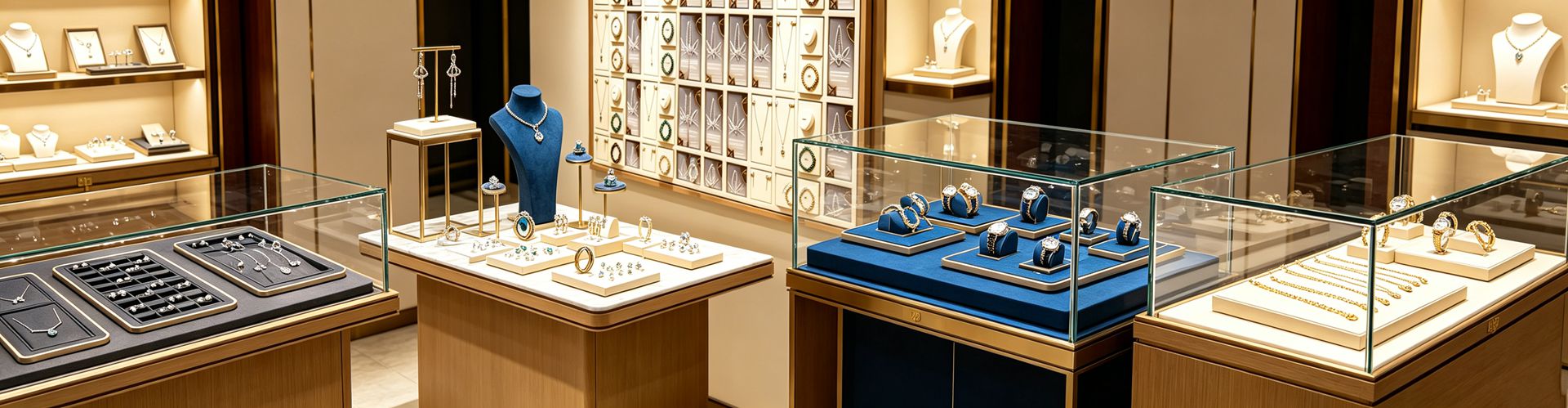
That rewrites the presentation brief. A watch box stops being a logo container. It has to hold the certificate, the numbered card, the signature page and the spare strap, and it has to survive a decade without loose hardware or a collapsed cushion — because the secondary market's premium for a full set is itself part of what these pieces are worth. Display props change too: half the appeal of an independent watch lives on the caseback side, so a stand that hides the movement is hiding the expensive part. A jewelry riser needs a height and angle designed for close inspection rather than a passing glance. And bespoke boxes shift from batch uniformity toward single-piece fit — putting a unique object into a generic box is a contradiction in the story you are telling. At Shenzhen Junyimei, the detail most often reworked on high-end watch and one-off projects is rarely the exterior; it is the internal fit and how it holds up ten years later.
In the end, this cycle rewards what cannot be replicated. Specifications can be copied, capacity can be stacked, marketing can be bought. A name, a craft refined over decades and the trust built around it cannot.
Auction rooms never remember output. They remember names.
This is original content. Copyright belongs to Shenzhen Junyimei.
Junyimei — present every jewel and timepiece at its best.
2026 年 6 月 14 日,纽约。一枚玫瑰金配铂金的腕表被推上拍台,竞投持续了将近九分钟,最终以 1390 万美元落槌。
它不是劳力士,不是百达翡丽,甚至不是任何一个能在免税店看到 logo 的名字。它出自 F.P. Journe——一个 1999 年创立、一年做不到一千只表的日内瓦独立品牌。这个价格创下独立制表师作品的世界纪录,也是二十一世纪腕表在非慈善拍卖中的最高成交价,更是自 2017 年保罗·纽曼那枚迪通拿之后美国拍场的最高金额。
过去两年行业的主流叙事一直是"退潮":热门钢款溢价崩塌、报价一路下修、中间价位段被掏空。但同一个市场里,一个年产九百只的作坊把价格推到了历史高点。钱没有离开腕表,它换了对象。
一组把趋势说透的数字
7 月 30 日,市场数据平台 EveryWatch 发布 2026 年上半年二级市场报告,样本覆盖 650 家经销商与近 500 家拍卖行。全球二手腕表交易额达 105 亿美元,同比增长 37.2%——交易额增速明显快于成交数量:人们不是买得更多,是买得更贵。
真正的爆点在独立制表:上半年合计成交 6.338 亿美元,同比增长 89%,超过 LVMH 集团整个制表阵营在二级市场的约 6.17 亿美元。一群作坊,跑赢了一个奢侈品帝国的钟表板块。
其中 F.P. Journe 一家贡献 2.016 亿美元,几乎是去年同期三倍,在全球腕表品牌二级市场价值榜上排第七。它的中位成交价同比上涨 82%,达到 21.5 万美元;周转率超过 57%——涨到这个价位仍有过半库存被消化,需求是真的。紧随其后的是 H. Moser & Cie. 的 2600 万美元(增长 64%)、帕玛强尼 2100 万美元(增长 60%)、De Bethune 1900 万美元(增长 2%)。
大牌并没有垮。劳力士依然是压舱石,以 42.9 亿美元占二级市场 41% 份额,百达翡丽 15.1 亿,爱彼 9.83 亿。但有个细节值得琢磨:劳力士官方认证二手(CPO)业务增长 101% 至 3.85 亿美元,首次超过二级市场上"全新未佩戴"表款的成交额。囤新表转手套利的玩法,正在被官方渠道和真实佩戴者接管。
这不是普涨,是一次分层
只看拍卖新闻,很容易误判成"腕表全面回暖"。摩根士丹利年度行业报告给出了另一半真相:瑞士腕表出口数量在下降,平均出口单价在上升;售价超过 5 万瑞郎的腕表,贡献了 2025 年行业增长的 89%。
增长几乎全部集中在最顶端的一小撮客群:顶级市场前所未有地强势,中低价位段相对脆弱。地域上同样在重新分配——上半年美国与加拿大二级市场增长近 70%,达到 45 亿美元;亚洲是唯一下滑的主要区域,跌了 2.6%。
拍卖行的战报同样印证。富艺斯钟表部上半年总成交额突破 2.35 亿美元,这在过去足够写满一整年的纪录。它在日内瓦、香港、纽约三地各拍出一枚千万美元级时计,为行业首创;纽约场 158 件拍品 100% 成交,连续五年半"白手套",16 枚突破百万美元。上半年全球成交价超百万美元的腕表接近去年同期三倍,达 73 枚。
从"品牌溢价"到"作者溢价"
把这些数字放在一起,会浮出一个更本质的变化:稀缺性的定义变了。
过去十年,热门运动钢表的稀缺是"制造"出来的——配货、排队、限量投放。这类稀缺一旦被识破价格就会崩,2024 年之后已经看得够多。而 F.P. Journe 一年九百到一千只的产量,对照百达翡丽约七万只、劳力士超过一百万只,是另一种性质的稀缺:不是营销策略,而是一双手的物理上限——没法靠扩产解决,也没法靠营销制造。
买家也换人了。富艺斯的数据显示,2025 年其钟表买家中有 35% 是新客户,千禧一代与 Z 世代合计接近三分之一。EveryWatch 联合创始人 Giovanni Prigigallo 的说法很直接:新一代藏家里有很多来自科技行业,他们真正着迷的是工艺,以及背后那些近乎偏执的细节;"拥有一枚独立制表作品,现在感觉像一个新资产类别刚开始的头几天。"
这句话既是看多,也是警告。他随后补的半句是——供给这么稀缺,价格还有上行空间。
藏在纪录背后的隐忧
天价成交对独立制表师并不全是好事。一件作品突然拍到千万美元,随之涌来的是雪片般的订单、询价和投机买家。而独立制表的产能不是产线,是人。订单可以一夜翻十倍,制表师的手不能。
更大的风险是金融化。看到拍卖纪录就以为"现在买入立刻赚钱",忽略了高价腕表并不等于容易变现:转售需要时间、渠道、佣金与市场气氛配合。EveryWatch 自己也提示了信号——上半年中位售出天数从 39 天延长到 43 天,这个数字值得盯着看。
再看中国。全球独立制表人协会 AHCI 只有约 35 名会员,来自十多个国家,中国面孔屈指可数:矫大羽是首位华人会员,马旭曙 2015 年入选,谭泽华 2019 年加入。马旭曙一年最多做出两枚表;广州的饶宽在自己工坊里几乎自制全部零件,只有发条、宝石与避震器例外。
反差刺眼:中国拥有全世界最强的钟表零部件制造能力,却长期被贴着"仿造"标签。差的从来不是手艺和设备,是署名权,以及围绕署名建立的那套叙事。这波行情的启示恰恰在此——市场愿意为一个具体的人付钱,前提是这个名字被清清楚楚放在作品上。

当产品以"人"为单位,呈现方式也要改
独立制表还带来一个容易被忽略的连锁反应:零售逻辑与品牌化产品完全不同。品牌卖统一识别,作坊卖单件叙事——一表一号、手写制作日志、大师签名卡,机芯每一处倒角都值得被指认。
这直接改写了呈现要求。手表盒不再只是印 logo 的容器,它得同时装下证书、编号卡、签名页与备用表带,还要保证十年后五金不松、内衬不塌——二级市场对"全套"的估值权重,本身就是这类作品价值的一部分。独立表的看点有一半在底盖那侧,展台若不能让机芯背面被看见,等于把最贵的部分藏了起来;珠宝摆台的高度与角度要为"细看"设计,而不是"扫一眼"。珠宝盒定制的思路也从批量统一转向单件适配——孤品配通用盒,本身就是叙事上的自相矛盾。深圳骏依美接到的高端表款与孤品项目里,最常被反复推敲的从来不是外观,而是内构贴合与十年后的耐久。
说到底,这轮行情奖励的是"不可复制"。产能可以堆,营销可以砸钱,唯独一个名字、一段几十年打磨出来的手艺,以及围绕它建立的信任,抄不走。
拍卖场记住的从来不是产量,是名字。
本文为原创内容,版权归深圳骏依美所有,转载请注明出处。
骏依美——让每一件珠宝与腕表,都被更好地呈现。