How Smart LED Lighting Turns Browsers Into Buyers让柜台自己会卖货
Most jewelers pour their budget into display props and inventory, yet overlook the beam of light inside the case — it is the invisible salesperson. Jewelry sells "value that is seen," and light is what makes that value visible for the first time.
Q1: Does lighting really move jewelry sales?
It does, and the effect is large. According to the Concept Lighting whitepaper, 70% of jewelry consumers say the lighting environment directly affects their purchase decision, and 83% of brands list display-lighting upgrades as their top store-renovation priority. The field data is blunt: after one international jewelry brand renovated 120 stores in China, average monthly sales per store rose 19.8% and average ticket size 27.3%, while the merchandise turnaround cycle shrank by 11 days. A Hong Kong–based group deployed 143 smart display units across Asia-Pacific and saw gemstone conversion climb 22 percentage points purely from dynamic lighting. On the optics themselves, the International Lighting Design Magazine (2022) found narrow-beam lighting lifts a diamond's sparkle by 40%, and the Retail Design Institute's case library records that angled lighting extends customer dwell time by 25%. Light is not decoration — it is the first lever of conversion.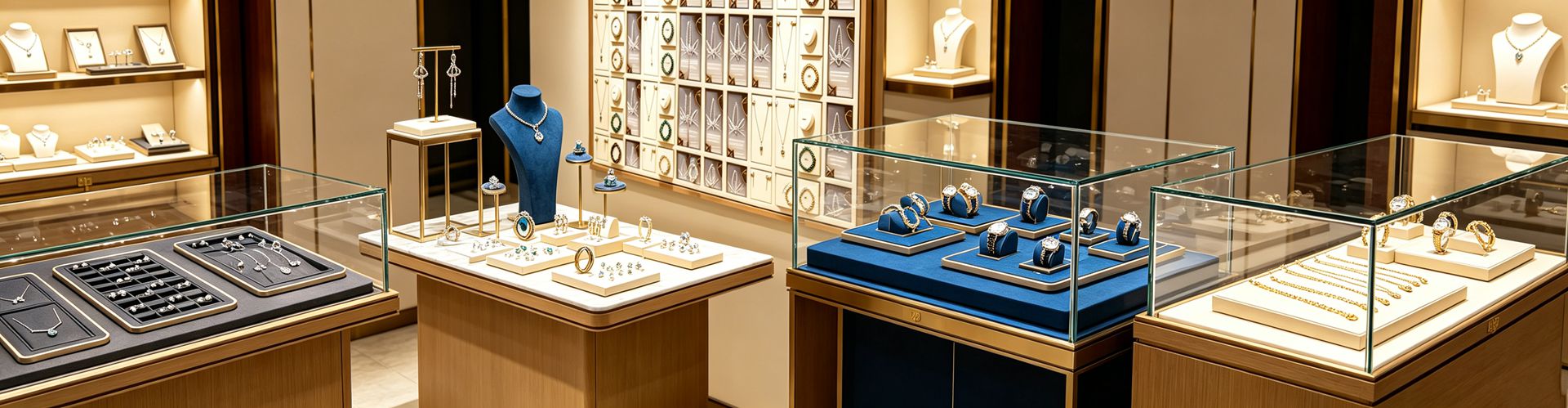
Q2: What color temperature and CRI should I actually use?
Two rules: match correlated color temperature (CCT) to the material, and keep color rendering index (CRI) high for fidelity. 3000K warm white flatters gold settings; 3500K–4000K neutral brings out a diamond's fire; 5000K–6500K cool white suits diamonds best at 1000–2000 lux. Keep global CRI at 90 or above, and boost the R9 component for colored stones like rubies so the main source does not wash out saturation. Layer the brightness: ambient light at 100–300 lux, the focused display zone at 1000–1500 lux — bright enough to reveal detail, never so bright it glares. Beam control matters too: use 10°–30° spots for emphasis and a 30° angled key light rather than a 90° top-down flood, which creates mirror glare. One easy-to-miss detail: a jewelry display stand and showcase should share the same lining color and surface material as the box interior. Dark for diamonds and platinum, light for gold and pearls, so the customer's eye never breaks between "looking" and "holding." Maintenance protects the gains: metal showcases should have LED modules swapped every six months, and any fitting with more than 10% light decay fails the standard — a dim case sells less than a bright one even with perfect product.
Q3: What makes smart LED better than ordinary lamps?
It is controllable, measurable, and cheaper to run. Among smart display fixtures, RFID inventory management already appears in 67%, dynamic LED scene lighting in 41%, and AI crowd analysis in 28%; smart dimming that auto-adjusts brightness to foot traffic saves over 30% energy on average. The market confirms the direction: in 2024 the smart LED jewelry-lamp segment grew 25% year-on-year to ¥12 billion, with smart controls penetrating 85% of high-power units. Scene presets are the most useful daily feature — Inspect (neutral white, bright, for appraisal), Display (warm/neutral white with subtle RGB, for merchandising), and Photo (daylight white, for shooting) — so the same case looks its best by day, by night, and on a livestream. Occupancy sensors and scheduling add the finishing touch: showcases stay bright when a customer is present and dim during lulls, protecting fragile settings from heat while cutting cost. At a Chow Tai Fook–style pilot, fire brilliance rose about 40%, dwell time 35%, and key-zone sales about 28%, with payback in roughly 14 months. The road ahead is predictive: analysts expect AI-driven dimming that pre-switches scenes before peak hours, IoT penetration in jewelry lighting reaching 45%, and AR virtual-try-on lighting-matching technology growing into an ¥800M+ market. Control standards matter too — choose Matter, Zigbee, or Thread if you want POS-triggered scenes or centralized management, and always keep a physical scene button so staff never need a phone to demo a ring.
Q4: Limited budget — what do I change first?
Order by return on spend: lamp, control, tag. A small shop need not go all-in. First swap the hero counters' sources for Ra≥95, 50,000-hour LEDs — lowest cost, fastest payoff. Second, add zoned dimming so reception, merchandising, and appraisal modes switch with one touch. Third, layer in RFID. A 300-store brand's measurement tells the story: per-store inventory counts dropped from 8 hours to 0.5, variance from 1.8% to 0.3%, and try-on-path data lifted conversion 8%–13%, with payback in 6–12 months. One link is often missed: high-end, minimalist jewelry packaging design is more readily favored by customers. A piece amplified by light inside the case loses its magic the moment it drops into a box with grey lining and messy flocking — the premium the store built evaporates in the last thirty centimeters. Restrained jewelry boxes and consistent packaging carry that "seen value" all the way into the customer's hand.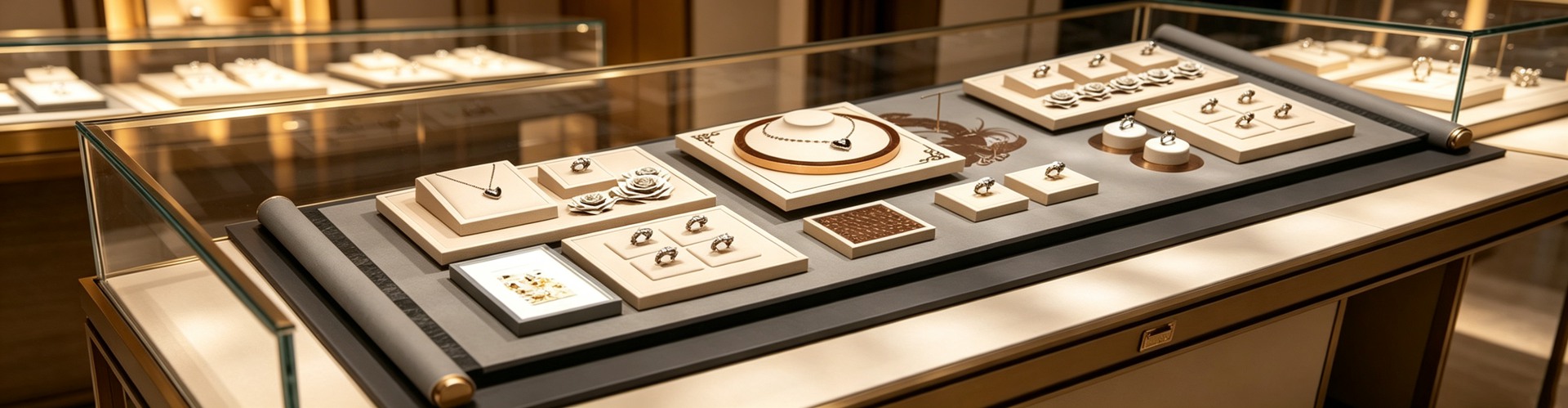
Q5: Light wins attention — how does packaging keep it?
This is the easiest link to break, and there are three practical fixes. First, match the display prop's background color to the box lining — dark for diamonds and platinum, light for gold and pearls — so there is no visual fault line. Second, make the display stand's cradle material and finish the same as the jewelry box, so the finger feels no texture gap moving from counter to box. Third, treat opening the box as a second lighting moment: flock direction, lid angle, and negative space should all serve the same beam. Shenzhen Junyimei, when kitting stores, reverses the in-case color temperature to the lining color code, so counter and handhold show one consistent texture. Light makes value seen the first time, the fixture makes it seen again and again, and packaging makes it remembered after leaving the store — only when the three are in tune do you have a complete merchandising language.
Q6: How do I prove the ROI instead of guessing?
Measure like a scientist, not a believer. Keep layout and merchandise constant, vary only the lighting scene, and track three KPIs: conversion at the display, average transaction value of highlighted items, and dwell time around the cabinet. A small artisan boutique that swapped in a targeted LED track system and programmable scenes saw average basket value rise 12% and time-on-display climb within a month; an independent jeweler using warm, low-angle accents during an anniversary campaign recorded 18% higher conversions on featured pieces. Energy math closes the case: Shenzhen Shuibei jewelry city's system retrofit saved 19.7% power — 652,000 kWh a year, worth about ¥632,000 and 672.2 tons of CO₂ — while GE's Riddle's jewelry LED project paid back in 14 months with subsidies and 20–22 months without. The premium is real but earned: display stands with basic smart features already price 43% above traditional products, and full smart-system customs can command a 120% premium. Before you buy, confirm four things: high CRI (≥95 ideal) with a tunable white range; published spectral data or independent tests for color accuracy; integration standards if you need centralized control; and physical preset support so scenes run without an app. Watch the pitfalls — keep RGB saturation low so inclusions stay visible, give staff a physical scene button rather than app-only control, and never leave task lights on high all day. Spend on what is measurable, and the lighting stops being a gimmick.
This is original content. Copyright belongs to Shenzhen Junyimei.
Junyimei — present every jewel and timepiece at its best.
很多店主把预算砸在珠宝陈列道具和货品上,却忽略了柜台里那束光——它才是看不见的导购。珠宝卖的是"被看见的价值",而灯光,负责让这价值第一次被看见。
问一:灯光真的能影响珠宝成交吗?
能,而且影响很大。畅想照明白皮书显示,70% 的珠宝消费者表示灯光环境直接影响购买决策,83% 的品牌将展示灯光升级列为店铺改造首要项目。实战更直白:某国际珠宝品牌中国区 120 家门店改造后,单店月均销售额提升 19.8%、客单价提高 27.3%;某港资集团在亚太部署 143 套智能展具,动态照明使宝石类转化率提高 22 个百分点。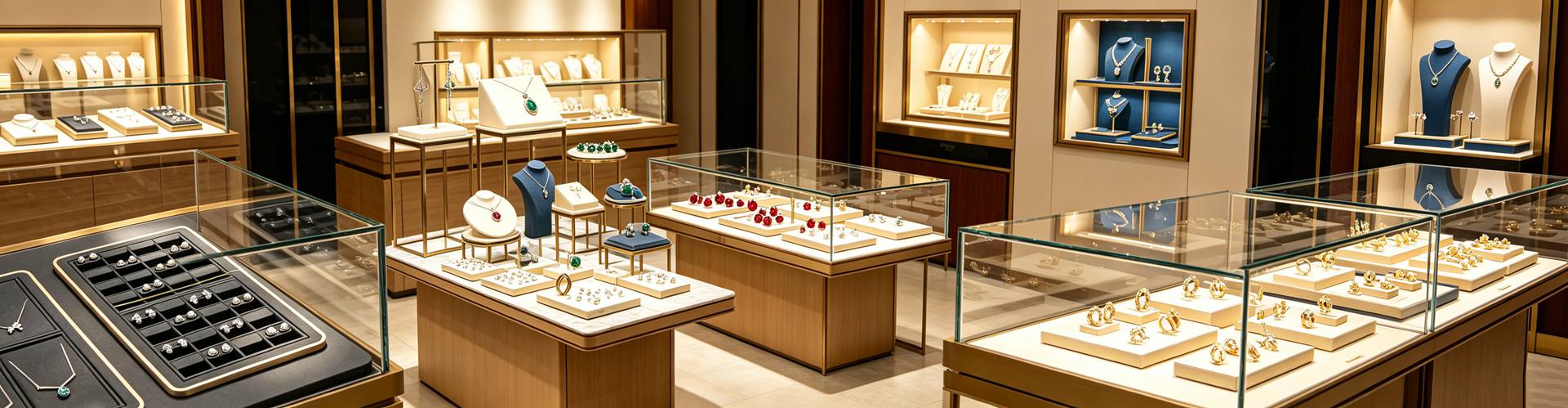 从光学看,《国际照明设计杂志》2022 年实验显示窄光束照明可使钻石闪烁度提升 40%;Retail Design Institute 案例则记录斜角照明让客户停留时间延长 25%。光不是装饰,是转化的第一杠杆。
问二:色温和显指到底怎么定?
核心两条:色温匹配材质,显指保真实。3000K 暖白增强黄金温润感,3500K–4000K 中性光凸显钻石火彩,5000K–6500K 冷白光最适钻石(照度 1000–2000lx)。全局 CRI 应≥90,对红宝石还要增强 R9 分量避免冲淡色彩。亮度要分层:基础环境光 100–300 lux,展品区聚焦 1000–1500 lux,避免刺眼又突出立体感。易断链的细节是——珠宝展示架与珠宝摆台的托面材质、内衬色,最好和盒内一致,深衬钻石与铂金、浅衬黄金与珍珠,别让视线在"看"和"拿"之间断层。
问三:智能 LED 比普通灯强在哪?
强在可控、可测、可省。智能展示架里 RFID 库存管理应用率 67%、动态 LED 情景照明 41%、AI 客群分析 28%;智能调光按客流自动调亮,平均节能 30% 以上。市场也印证:2024 年智能 LED 珠宝灯市场同比增 25%、达 120 亿元,智能控制系统渗透率 85%。场景一键切换最实用——Inspect(中性白高亮,鉴赏)、Display(暖/中性白加微 RGB,陈列)、Photo(日光白,拍摄)。潮宏基改造案例里,宝石火彩度提升约 40%、驻足增加 35%、重点区销售额提升约 28%,回收期仅约 14 个月。
问四:预算有限,第一步该改什么?
按投入产出排序:灯、控、标。小店先把重点柜光源换成 Ra≥95、寿命 5 万小时 LED,成本最低、见效最快;第二步做分区调光,让接待、陈列、鉴赏三模式一键切换;第三步再上 RFID。某 300 店品牌实测:盘点 8 小时→0.5 小时,差异率 1.8%→0.3%,试戴路径数据使转化率提升 8%–13%,回本通常 6–12 个月。这里常被忽略:高端简约的珠宝首饰包装设计,更容易被顾客青睐。柜台里被灯光放大的珠宝,若装进内衬泛灰、绒面杂乱的盒子,开盒瞬间的落差会抵消门店的高级感。用克制的首饰盒和统一质感的珠宝包装,才能让"被看见的价值"延续到顾客手中。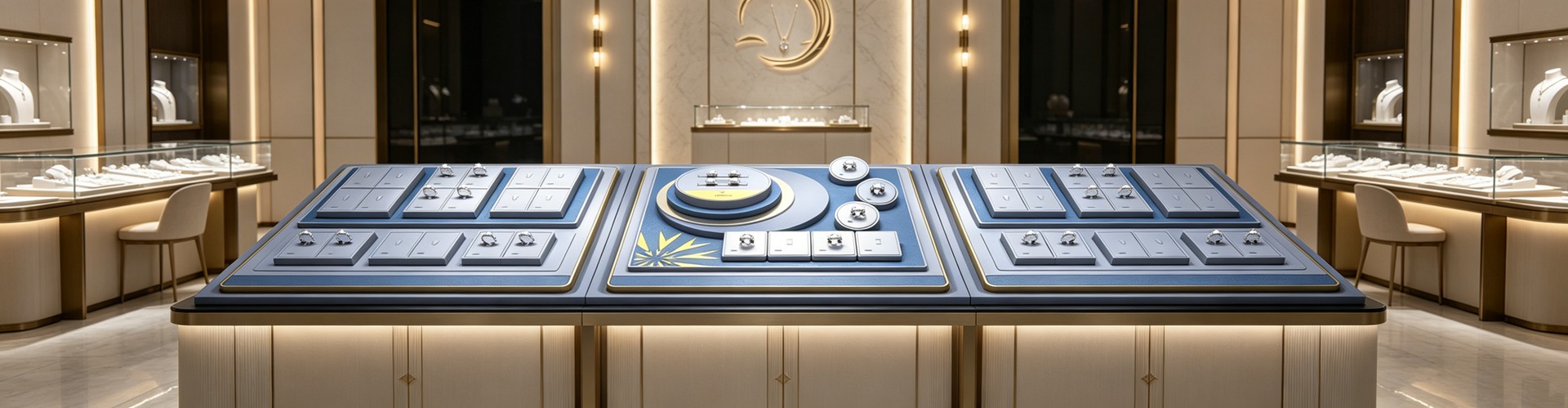
问五:灯光留住了人,包装怎么接住?
三条可落地做法。其一,让珠宝陈列道具背景色与盒内衬色同属一个体系,深衬钻石与铂金、浅衬黄金与珍珠;其二,珠宝摆台托面材质与首饰盒设计同料同工艺,手指从展台移到盒中不产生质感落差;其三,把开盒视作"第二次打光",内衬绒毛倒向、盒盖角度、留白比例都服务于同一束光。深圳骏依美为门店配套时,按主销品类柜内色温反推内衬色号,让柜台与手中同一种质感。灯让价值第一次被看见,展具让它被反复看见,包装让它离店后还能被记住——三者同频,才算一套完整的陈列语言。
本文为原创内容,版权归深圳骏依美所有,转载请注明出处。
骏依美——让每一件珠宝与腕表,都被更好地呈现。