Why Your Box Sells on a Live Stream珠宝盒为何要上镜
On a live stream, the host lifts a ring out of its box and the chat immediately floods with "so premium." What almost nobody notices is that, before the ring, the audience saw the box. In live commerce, jewelry packaging and display props stop being an afterthought and step in front of the camera to share the job of closing the sale.
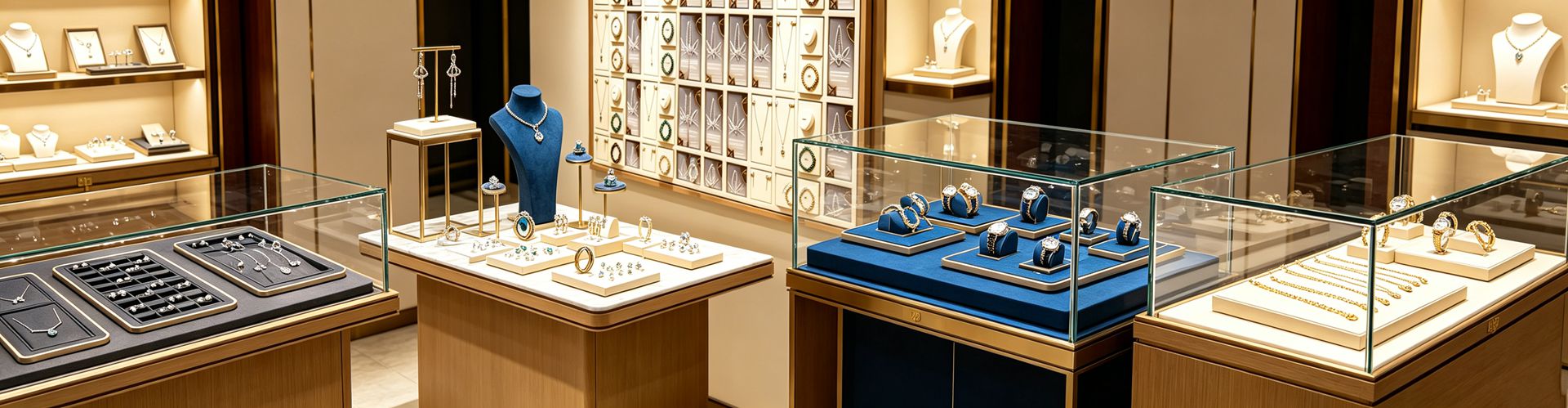
Q: When you sell jewelry live, does the box also have to "look good on camera"?
A: Yes—and more so than in a store. A live stream is a contract of "what you see is what you get," and every frame the lens captures is a promise. According to the Gem & Jewelry Trade Association of China, the national jewelry and jade retail total reached 720 billion yuan in 2025, online channels crossed 35% of sales, and live commerce alone drove 62% of that online revenue. In Shenzhen's Shuibei district, the 2026 Qixi live-season special pulled over 1 billion yuan across two platforms, with single sessions drawing more than two million viewers. China's live-commerce market as a whole is projected at roughly 6.95 trillion yuan for 2025 and 8.16 trillion for 2026. When thousands watch at once, the packaging is the first frame of trust. This is exactly why quiet, high-end jewelry packaging tends to win customers: on a phone screen under a beauty-ring light, an all-over gold-foil box smears into noise, while a solid matte box reads cleanly even five meters away; moving the budget from decoration to structural tolerances—fold precision, magnet strength—is what survives the zoom. Factories like Shenzhen Junyimei now get most of their live-commerce orders with "camera-friendly" written into the brief. The same logic applies to the in-hand experience: a clean box that survives the zoom also survives being filmed again by the buyer, turning the unboxing into free, on-brand content that no paid ad can fake. Data backs the instinct: among live jewelry buyers the deciding moments are visual, and a cluttered box steals the spotlight from the stone exactly when attention is scarcest. A calm surface lets the gem be the only loud thing on screen.
Q: How are live-stream display props different from a store counter?
A: A counter is built for the person who walks up; a live set is built for the lens, and the logic is opposite. Live jewelry display props solve three problems: true color, magnification, stability. A ring-light turns luster, skin and inclusions into visible "selling points"—one report found seawater-pearl pendants converting at 12.7% live versus just 3.2% on the same store's photo page, because the camera pushes to 8K and viewers can count the growth lines. Add a non-glare velvet turntable, a macro loupe, and a jewelry display stand, and the host shows detail one-handed. These jewelry display props are not decoration; they are trust amplifiers. The clearer the viewer sees, the faster they buy. Shuibei's live bases now run annual GMV above 10 billion yuan precisely because the whole staging—light, surface, angle—is engineered for the camera rather than the footfall. Critically, consistent on-stream color temperature is what separates a trustworthy live room from a misleading one; when the prop lighting matches the inspection certificate's conditions, the not-like-the-photo complaint drops before it starts. Good hosts even keep a second, neutral prop behind the hero piece so the eye has a calm reference, which is another reason minimalist packaging outperforms busy designs under continuous close-up.
Q: Live returns are notorious—can the box help?
A: It can, and it owns the "last mile." High conversion on live often rides with high returns: the same jade-live research put Douyin-channel returns near 23%, versus just 7% on the more credentialed JD.com, and nearly one in five shoppers scored the return experience only 1–2 out of 5. Color mismatch, flaws, and "not like the lighting on stream" top the complaints. Packaging's job is to make "what arrives" match "what was streamed": shock-absorbing inserts keep the setting from shifting, individual slots fix each center stone, an opaque jewelry pouch shields delicate colored stones from humidity and oxidation, and the original box lets the customer confirm "exactly like the live room" on opening. A well-built jewelry box keeps fold error within 0.2 mm and lining snug, so nothing looks crushed or dirty on arrival—cutting "not as described" returns at the source. In a category where returns silently eat margin, the box is the cheapest insurance a seller has. For moisture-sensitive stones such as pearls and opals, that opaque pouch is not a nicety—it is the difference between a five-star review and an arrived-cloudy dispute. The packaging, not the live room, is what protects value across the delivery gap, and a buyer who receives the piece exactly as promised is the buyer who comes back.
Q: How do you use packaging to build trust and fight fakes on live?
A: The biggest trust gap in live selling is "is it real." In jade-live surveys, only 53% of buyers would recommend the product to a friend, mostly for fear of misleading others or fakes; so-called "smart authentication" reached just 4% penetration among buyers. That is where packaging is the cheapest, most visible trust certificate. A one-item-one-certificate card travels in the box, a pre-ship inspection certificate sits inside, a blockchain trace code prints on the seal—and the original box itself becomes a physical anti-counterfeit fingerprint. Shenzhen Junyimei's custom jewelry box service often pre-reserves the trace-code slot and NFC contact point so a minimalist surface gives that one mark a clean landing; busy patterns only shelter counterfeiters. On stream the original box is shown again and again, quietly telling the viewer: from factory to your hands, no one swapped it. When the product is non-standard and high-involvement, that quiet proof is worth more than any slogan. Platforms are already nudging this direction: Douyin and Taobao are testing AI and blockchain certificates synced to the order page, and pilots that inspect before ship have lifted average order value while cutting returns. The box is the physical half of that digital promise—without it, the certificate is just a PDF nobody films, and the trust it claims never reaches the screen.
Q: For the unboxing moment, how should the box be designed to "open well for the camera"?
A: Live pacing is counted in seconds, so unpacking cannot drag. A good live-ready jewelry box is "one-hand open, reveal on lift": a magnetic lid flips with a push, the lining rises in a curtain-style reveal, velvet sheds no lint and throws no glare. Nested boxes and stiff clips only make the host fumble on camera and lose trust. Minimalist boxes hide their craft in the opening mechanics—magnet calibration, hinge life, lid rebound—and those invisible KPIs decide whether the on-stream "click" is crisp. A watch box on live is even more deliberate: opening reveals the movement and the arc of the strap at once, and the watch display prop tilts to catch exactly the right highlight, explaining "worth it" in a single second. The box is not just a container here; it is a co-star in the performance. And the sound matters too: a clean magnetic click reads as quality on a live mic, whereas rattling inserts or tearing tape read as cheap, and the audio of the unbox is part of the show. Viewers may forgive a slow explanation, but they rarely forgive a box that sounds like it came from a dollar store.
Q: Small budget—how does a new seller start with live packaging?
A: Not by piling on material, but by spending the right money on structural tolerances. Solid specialty paper with blind-embossing, water-based glue instead of solvent glue—less odor, cleaner on camera; swappable holiday sleeves let one box body carry the whole year's rhythm and avoid post-holiday dead stock; move the budget from broad gold foil to three places—fold precision, lining fit, magnet calibration—and both the on-camera feel and the in-hand feel arrive together. Many new Shuibei brands first ran live with a small-batch custom jewelry box, then upgraded. One top MCN in Ruili piloted "inspect before ship" and cut returns by 6 points while raising average order value 12%—trust itself carries a premium. Packaging is rarely the most expensive link, yet it is the first the viewer remembers and the last they confirm. Start with one well-made universal box in a calm color, print your trace code on the seal, and let the jewelry—not the packaging—do the talking. That single discipline already puts a small seller ahead of most of the noisy, over-decorated boxes competing for the same eyeballs. Get the box right, and the live room sells the jewelry twice: once on screen, once in the hand.
This is original content. Copyright belongs to Shenzhen Junyimei.
Junyimei — present every jewel and timepiece at its best.
直播间里,主播把一枚戒指从盒子里托出来,弹幕立刻刷起"好高级"。可很少有人注意到——在那枚戒指之前,观众先看到的是盒子。在直播电商这条赛道上,珠宝包装和陈列道具第一次不再是"售后配角",而是和珠宝一起出镜、一起承担转化的主角。
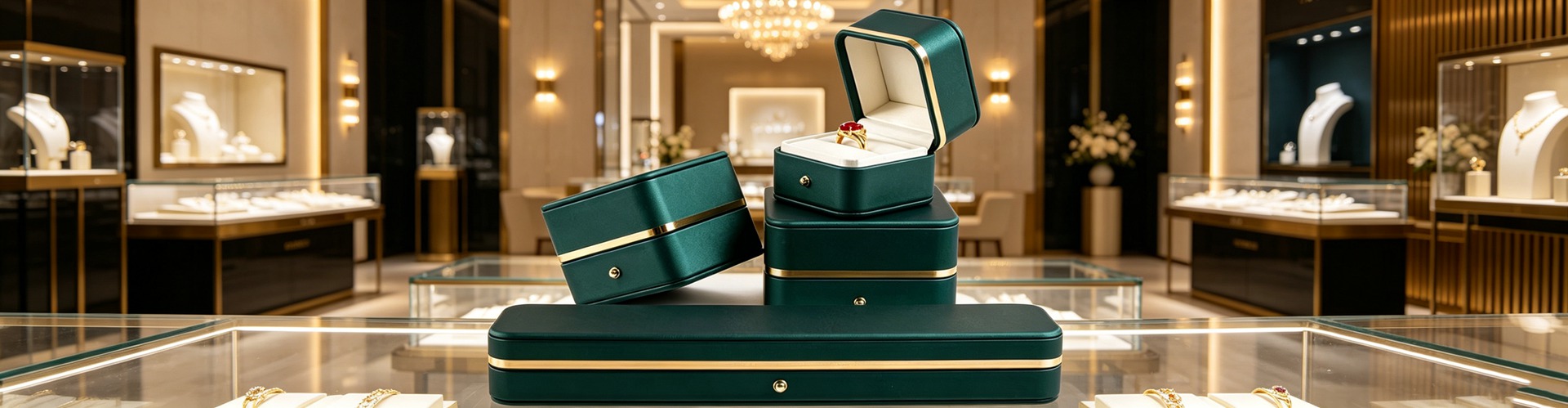
问:直播卖珠宝,盒子也要"上镜"吗?
答:要,而且比线下更较真。直播本质是"所见即所得"的契约,镜头拍到的每一帧都是承诺。据中国珠宝玉石首饰行业协会数据,2025 年全国珠宝玉石首饰零售总额达 7200 亿元,线上渠道占比突破 35%,其中直播电商贡献了线上销售额的 62%;深圳水贝的电商直播季,今年"七夕"专场双平台销售额已突破 10 亿元,单场观看超 200 万人次。当几千人同时盯着屏幕,包装就是珠宝的"第一帧信任"。这也是为什么高端简约的珠宝包装反而更容易被顾客青睐:手机小屏加美颜柔光下,满版烫金的盒面往往糊成一团噪点,而纯色哑面的极简首饰盒五米外可辨、镜头里干净利落;把预算从花纹挪到折边精度、磁吸力度这些结构公差上,盒子的"高级感"才经得起放大。像深圳骏依美这类珠宝盒工厂,近年接到的直播专供订单,几乎都指向"上镜友好"这一条。
问:直播间的陈列道具,和柜台里有什么不一样?
答:柜台陈列是给"走到面前的人"看的,直播陈列是给"镜头"看的,逻辑完全不同。直播需要的珠宝陈列道具,核心是解决三件事:显色、放大、稳定。环形柔光灯把珠光、皮色、瑕痕放大成可视的"爽点"——华信人咨询报告显示,天然珍珠直播里海水珠吊坠的转化率能做到 12.7%,是同店图文页 3.2% 的四倍,关键就在镜头怼到 8K、连生长纹都能数清。再配上一块不反光的绒布旋转台、一个微距放大镜、一只珠宝摆台,主播单手就能把细节推到观众眼前。这类首饰展台和珠宝展示架在直播里不是装饰,而是"信任放大器":观众看得越清楚,下单越果断。
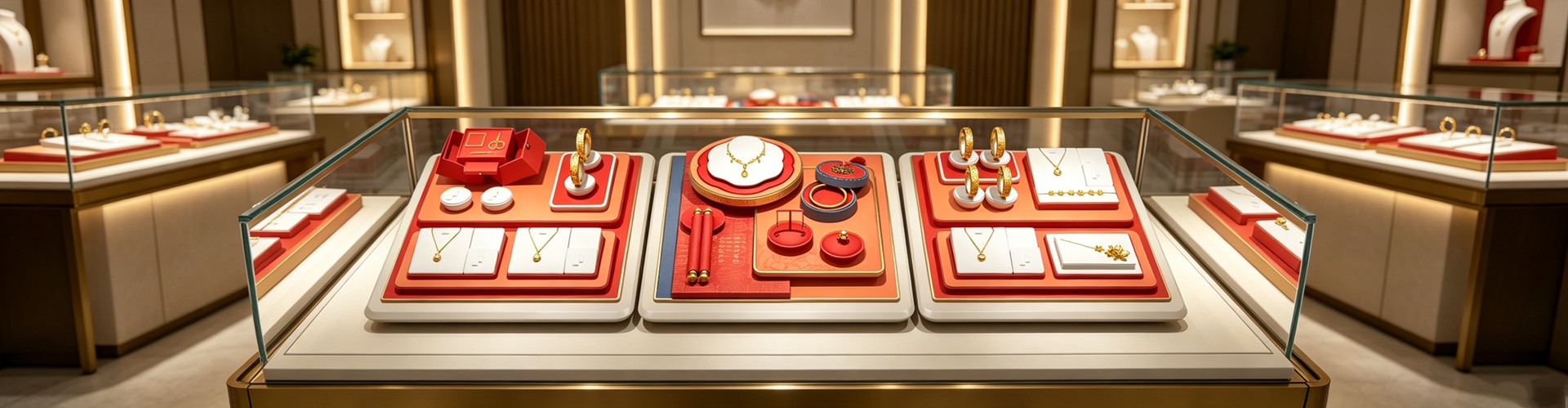
问:直播退货率那么高,盒子能管这事吗?
答:能,而且管的是"最后一公里"。直播的高转化往往伴随高退货——同一份翡翠直播调研显示,抖音渠道退货率约 23%,而背书更强的京东仅 7%;近两成消费者给退货体验只打 1—2 分,色差、瑕疵、与直播灯光效果不符是头号原因。包装要做的,是让"收到货"和"看直播"尽量一致:防压内衬托住戒托不位移,独立卡槽固定每颗主石,不透光的首饰袋替娇气彩宝挡住潮气与氧化,原装盒则让顾客拆开时确认"和直播间里一模一样"。一件结构扎实的饰品包装盒,折边误差控制在 0.2 毫米以内、内衬服帖不松垮,运输到家才不会显脏、塌陷,把"货不对板"的退货从源头压下去。
问:直播里怎么用包装建立信任、防住假货?
答:直播最大的信任缺口,是"真假难辨"。调研里翡翠消费者愿把商品推荐给朋友的只有 53%,主因就是怕误导、怕假货;所谓"智能鉴定"在已购人群里渗透率仅 4%。这时候,包装是成本最低、最可见的信任凭证。一物一证的鉴定卡随盒走、先检后发的证书嵌在盒内、区块链溯源码印在封签上,原装盒本身就成了一枚"物理防伪指纹"。深圳骏依美的珠宝盒定制服务,常把溯源码位、NFC 触点位提前留好,让极简盒面给这枚标识一个干净落点——繁复花纹反而给仿冒留了掩护。原装盒在直播里被反复展示,它替品牌说了一句最硬的话:这东西,从出厂到您手里,没换过人。
问:开箱环节,盒子怎么设计才"好拆给观众看"?
答:直播的节奏是按秒算的,拆包装不能拖。好的直播专供首饰盒,讲究"单手秒开、揭幕即见":磁吸翻盖一推即开,内衬做成缓缓托起珠宝的"揭幕式",绒布不飞絮、不反光抢戏。繁复的套叠盒、要用力抠的卡扣,在镜头前只会让主播手忙脚乱、掉粉掉信任。极简盒把功夫藏在开合力学里——磁吸力度标定、铰链寿命、盖板回弹,这些看不见的 KPI,决定了直播里那一下"咔哒"是否干脆。手表盒在直播里更讲究:开盖同时露出机芯与表带弧度,手表陈列道具的倾斜角度要刚好让镜头吃到反光的高光带,一秒讲清"值不值"。
问:小商家预算有限,直播包装怎么起步?
答:不靠堆料,靠"把对的钱花在结构公差上"。纯色特种纸加盲压、水性胶替代溶剂胶,气味少、镜头里干净;可换的节日封套让同一只盒身扛住全年节奏,避免节后库存;把预算从大面积烫金挪到折边精度、内衬贴合、磁吸标定这三处,盒子的"上镜感"和"到手感"同时到位。水贝不少新品牌就是先用小批量珠宝盒定制跑通直播,再慢慢升级。瑞丽有头部 MCN 试点"先检后发",退货率降了 6 个百分点、客单价反而升了 12%——信任本身就能溢价。包装不是最贵的那一环,却是观众最先记住、也最后确认的那一环。
本文为原创内容,版权归深圳骏依美所有,转载请注明出处。
骏依美——让每一件珠宝与腕表,都被更好地呈现。