Why Men Are Finally Buying Their Own Jewelry男士珠宝的觉醒
In June, the men's creative director at Christian Louboutin unveiled his first autumn/winter collection. Alongside the footwear came something the house had never shipped at that scale before: a full line of jewellery, eyewear and accessories. Two months earlier, Tommy Hilfiger had launched its first dedicated men's jewellery range in partnership with a European jewellery and watch wholesaler, covering steel and leather bracelets, chains and cufflinks. In July, a lifestyle label that had spent nearly a decade selling women's jewellery introduced men's chain necklaces as its entry into menswear.
None of these companies is a traditional jeweller. All of them decided, within a single season, that men's jewellery now belongs in the assortment. That is the clearest signal available about where this category is heading.
Nobody agrees on the size of the market — and that matters
Try to size men's jewellery and you run into a strange problem: credible research houses disagree by a factor of five. One model puts the category at roughly US$35.5 billion in 2025, growing to about US$57.6 billion by 2032 at a 7.15% compound annual rate, with rings the largest product type at 35.6% of sales, gold the leading material at 39.6%, and Asia-Pacific ahead at about US$12.2 billion versus US$10.9 billion in North America and US$9.1 billion in Europe. A second house models US$49.7 billion in 2025 rising to US$88.5 billion by 2031, a 10.1% CAGR. A third counts barely US$9.3 billion.
The gap is not a failure of arithmetic. It is a definitional argument. Does a stainless steel chain count as jewellery or as an accessory? Do wedding bands belong in men's or in bridal? Where do deliberately genderless designs get filed? A category whose boundaries are still being drawn is, almost by definition, a category in its early innings. And on one point every model converges: men's jewellery is now compounding at 7% to 8% a year, against 2% to 3% only a few years ago. The acceleration says more than the absolute number.
The shift that actually changes the business: men are buying for themselves
Roughly 35% of men now buy jewellery for themselves, against 42% of women — a gap of under eight percentage points. For a category historically sold through wives, girlfriends and mothers, that is a structural break rather than a seasonal blip.
It matters because purchase intent rewires product requirements. A woman buying a bracelet as a gift optimises for how it will look when the box opens. A man buying the same bracelet for himself optimises for whether he can shower in it, whether it will still look right in month fourteen, and whether it fights with the watch already on that wrist. Self-purchase drags a category toward durability, low maintenance and everyday wearability — and away from occasion-only design.
The brands responding fastest have understood this. David Yurman's new hand-engraved amulets turn Zeus, Ares, Poseidon and Apollo into wearable talismans, selling meaning rather than carat weight. Norway's Tom Wood reworked the classic curb link into its River collection in recycled silver and gold, describing it explicitly as an argument for stacking: bold or pared down, single metal or mixed. John Hardy's Heishi Gem bracelets push colour into men's stacks with cushion-cut peridot, sky blue topaz and lemon quartz framed by lapis and turquoise beads. Symbolism, stackability and colour — three things a men's jewellery range was not expected to offer five years ago.
Three millimetres, and the physics of masculine taste
The most revealing data in this category is not about culture. It is about specification. Wholesale observation suggests around 75% of male buyers prefer stainless steel to sterling silver — not on price, but because they refuse to polish anything. Matte and brushed finishes outsell high polish by roughly three to one. Black ion-plated pieces are growing about 40% year on year. And thickness functions as a hard line: chains under three millimetres read as feminine to most male buyers, which is why cable chains typically start at 3mm and Cuban links at 5mm. Search behaviour confirms the pull, with queries for men's bracelets up around 230% year on year and men's necklaces up about 180%.
Put those together and a rule emerges. Women's jewellery is priced in a language of weight and stones. Men's jewellery is priced in a language of thickness and surface finish. The same plain chain at 3mm and 5mm is effectively two different products. The same steel, polished versus brushed, addresses two different customers. This also explains why men's lines skew minimal without anyone forcing them to: the male buyer is not asking for ornament, he is asking for something that looks solid, feels weighted and survives a year unchanged.
The customer base has already segmented. Streetwear buyers aged 16 to 25 take Cuban chains and pendants at roughly US$30 to US$80. The professional segment, 25 to 40, wants slim cable chains and ID bracelets at US$50 to US$150. A near-luxury tier of 30 to 50 year olds buys signet rings and cufflinks at US$150 to US$500. The first two groups together account for something like 60% of all men's jewellery purchases — meaning the real contest is in the middle of the price ladder, not at the top.
Culture did the groundwork. Hip-hop and K-pop normalised heavy chains long before luxury houses arrived, and figures such as Harry Styles, A$AP Rocky and Timothée Chalamet made pearls, layered necklaces and stacked rings unremarkable on a male red carpet. But celebrity influence is the oldest force in this category and explains only the visibility, not the economics. What has changed underneath is quieter: engraving and monogramming have become standard service lines, brands increasingly file minimal designs as unisex rather than splitting them by gender, and 3D-printed prototyping has made small-batch bespoke work commercially viable for studios that could never have carried the tooling cost before. Personalisation converts a trend purchase into an attachment, which is exactly what a category built on daily wear needs.

China: the share of male buyers has doubled in five years
China's numbers are unusually concrete. Male accessory buyers have gone from about 8% of all jewellery shoppers five years ago to roughly 16% in 2026, with the associated market passing RMB 77 billion. Typical spend clusters between RMB 500 and RMB 1,500. Preferred materials are titanium steel, sterling silver and black agate. The dominant aesthetics are hip-hop, e-sports and industrial minimalism, and the buying occasions split three ways: festival gifting, couples' bands, and self-reward.
The genderless shortlist circulating among Chinese retailers is strikingly consistent with the global one — plain matte bands, heavy Cuban chains in gold, wide open cuffs, geometric tag pendants, pared-back crosses. Cultural drivers differ market to market; the physical product converges.
The counter has no place for him
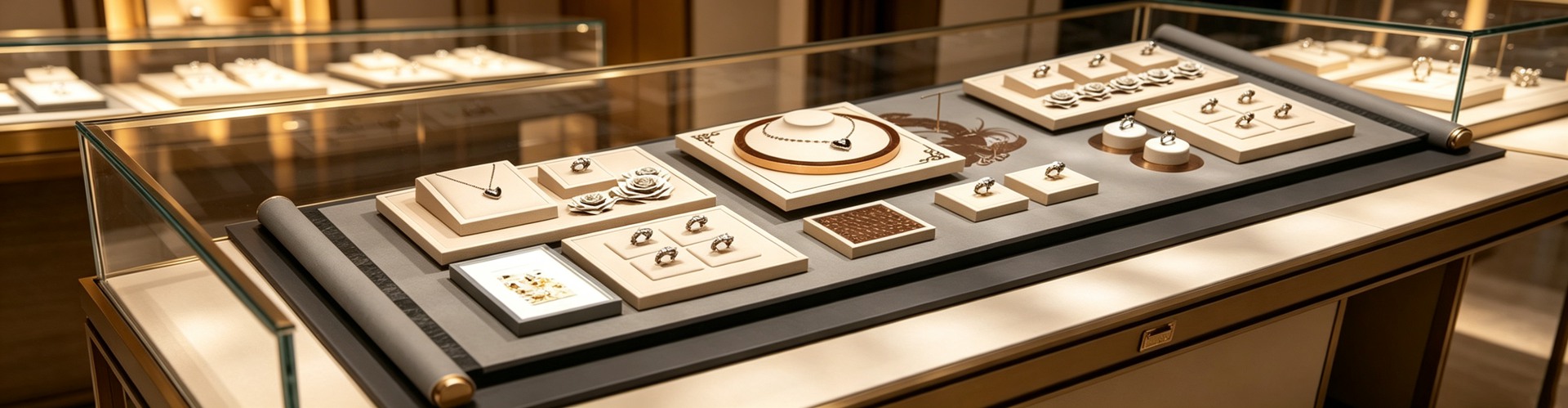
Retail presentation is lagging the category badly. Walk into most jewellery stores and the men's assortment occupies one tray at the end of the customer path, displayed on the same warm velvet and high-gloss risers used for everything else. Those props actively work against the product: warm velvet under bright light makes titanium steel and matte black look cheap, flattening the cold, hard, weighted qualities the piece was designed to convey.
Several fixes are concrete. Jewelry display props for a men's bay need a neutral, cool-grey, low-sheen vocabulary, and risers that genuinely carry the weight of a heavy chain without sagging. Male shoppers dwell for shorter periods and dislike being watched, so the try-on position should be its own station with an adjustable mirror rather than a shared corner of the women's case.
Stacking changes the packaging brief just as much. One customer now owns several pieces, so interior compartments must shift from staging a single hero item to storing three to five chains that never tangle or scratch each other. Jewelry box design has to be rewritten too: self-purchase is an audience-free act, and a man who bought his own chain does not want pink ribbon and script type. He wants something cool-toned, matte, openable with one hand, and good enough to live permanently on a nightstand. For custom jewelry boxes, compartment layouts, chain-length clearance and wider ring slots all need re-specifying — inherited women's dimensions simply will not take a 5mm Cuban link. The approach Shenzhen Junyimei has argued for all along applies cleanly here: move budget out of surface decoration and into structural tolerance, because a male customer was never going to be won by a pattern.
The verdict: this category will be decided on endurance, not nerve
There is an obvious trap. Low unit prices and fuzzy boundaries tempt brands to run men's jewellery as an accessories business — fast supply chain, high volume, ride the trend. But the repeat-purchase logic runs the other way. Men's jewellery earns trust through daily wear, and when a piece discolours, loses plating or snags a sweater, the customer does not trade up. He exits the category permanently.
Which is why the barrier to entry here is not boldness of design. It is a much plainer question: after a year on the body, does it still look new? Brands have to answer that. So do the counters and the boxes.
This is original content. Copyright belongs to Shenzhen Junyimei.
Junyimei — present every jewel and timepiece at its best.
八月中旬,一份面向行业的男士珠宝风格指南在珠宝圈流传。它列的新品清单值得玩味:David Yurman 推出手工雕刻的男士护身符吊坠,把宙斯、阿瑞斯、波塞冬、阿波罗做成可佩戴的图腾;挪威品牌 Tom Wood 发布 River 系列,用再生银与金重塑经典古巴链节,官方说法是"这是一组关于叠戴的宣言——大胆或极简,单一金属或混搭,随你组合";John Hardy 的 Heishi Gem 系列则把枕形切割橄榄石与天空蓝托帕石塞进男士手链,外圈点缀青金石与绿松石珠。
三个品牌,三种路径,但有一个共同点:它们谈论男士珠宝的方式,和五年前完全不同。五年前,这个品类在多数珠宝店的语言体系里只有两个词——袖扣,婚戒。
没人说得清这个市场有多大,这本身就是信号
去查市场规模,会撞上一个尴尬现实:几份主流报告的数字差了五倍。一份行业研究给出的口径是,男士珠宝 2025 年约 355 亿美元,2032 年增至约 576 亿美元,年复合增速 7.15%;其中戒指占 35.6% 为最大品类,黄金以 39.6% 居材质首位,亚太区约 122 亿美元领先北美的 109 亿。另一家机构的模型则是 2025 年 497 亿美元、2031 年 885 亿美元,年复合增速 10.1%。
差异不是谁算错了,而是"什么算男士珠宝"至今没有共识:钛钢链条算不算,婚戒算不算,中性设计该归哪一栏。一个连边界都没划清的品类,正是爆发早期的明证。而所有口径都同意一件事:男士珠宝的年增速已经稳定在 7% 到 8%,而几年前只有 2% 到 3%。加速度,比绝对值更能说明问题。
中国的数字更具体:占比翻倍,规模七百七十亿
国内市场给出的画像清晰得多。综合行业协会与第三方调研,男性饰品消费者占比已从五年前的 8% 升至 2026 年的 16%——五年翻倍,对应市场规模突破 770 亿元。客单价集中在 500 到 1500 元,材质偏爱钛钢、纯银与黑玛瑙,风格集中在嘻哈、电竞与极简工业,购买场景是节日礼物、情侣对戒和自我奖励三条主线。
再放上另一组数据,趋势的性质就变了:目前男性自购珠宝的比例约 35%,女性为 42%,相差不到 8 个百分点。这是整个故事里最关键的数字。过去的销售逻辑是女性替男性买——妻子挑婚戒,女友选礼物,母亲添手链。而一个品类只有在使用者自己掏钱时才会真正开始进化:因为只有他会关心第二年会不会掉漆、洗澡要不要摘、和手表戴在同一只手腕上是否打架。
品牌的入场速度,说明它已成为"男装完整度"的一部分
2026 年这一轮上新格外密集。Tommy Hilfiger 与欧洲珠宝手表零售商的批发部门合作,推出首个男士珠宝系列,产品覆盖精钢与皮革材质的手镯、项链和袖扣。古驰、纪梵希、葆蝶家、卡地亚、宝诗龙也已通过项链、皮革手镯与戒指进场,价格带千元到万元。六月初,Christian Louboutin 男装创意总监的首个秋冬系列除鞋履之外一并放出完整珠宝线;七月,一个原本只做女性饰品的生活方式品牌把男士链条项链作为首个男装单品推出。
当鞋履、成衣与生活方式品牌都开始把珠宝装进男装系列,意味着它不再是柜台角落的补充 SKU,而成了"一套男装完整不完整"的判断标准之一。这个转变对传统珠宝零售商是坏消息——竞争者从同行变成了全体服饰品牌。
三毫米:一条被忽略的性别分界线
真正有意思的差异藏在参数里。批发端的观察显示,约 75% 的男性买家偏好不锈钢而非白银——不是买不起,是不想保养;哑光与拉丝饰面的销量是高抛光的三倍;黑色离子镀产品同比增长约 40%。最耐人寻味的是厚度:3 毫米以下的链条会被男性买家直觉判定为"偏女性",因此缆链一般从 3 毫米起做,古巴链从 5 毫米起。搜索侧同样在涨——"男士手链"同比上升约 230%,"男士项链"约 180%。
把这些拼起来会得到一个结论:女装珠宝的定价语言是克重与宝石,男装珠宝的定价语言是厚度与表面处理。同样一条素链,宽 3 毫米和 5 毫米卖的是两种商品;同样的钛钢,抛亮和做哑与拉丝面对的是两类客人。这也解释了男士线为何天然偏向极简——男性买家要的不是繁复,而是"看起来结实、摸起来有分量、一年后还没变样"。
客群也已分层:16 至 25 岁的街头风偏好古巴链与吊牌,单价 30 到 80 美元;25 至 40 岁的职业段选细缆链与 ID 手链,50 到 150 美元;30 至 50 岁的轻奢段买印章戒与袖扣,150 到 500 美元。前两段合计约占男士珠宝购买量的六成——真正的战场在中间价位,不在天价的宣言式单品。
柜台里没有男人的位置
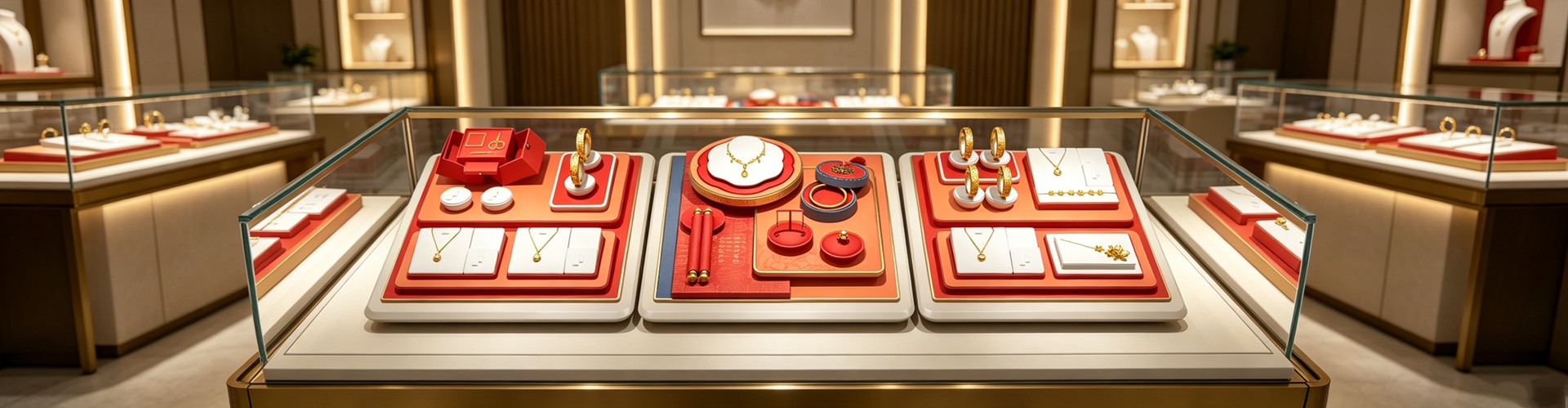
品类跑在了呈现前面。走进大多数珠宝门店,男士产品仍被塞在动线末端的一格,用同一套绒面高光托盘展示——而绒面暖光恰恰会把钛钢与哑光黑照得发廉价,把男士产品最想传达的"冷、硬、有分量"抹平。这里有几件很具体的事要改:珠宝陈列道具需要一套中性冷灰、低反光的哑面语言,托台还要真正承得住粗链的重量而不塌陷;男性顾客停留时间短、不喜欢被围观,试戴位应当独立、镜面高度可调,而不是共用女士柜的镜子。
叠戴带来的变化更硬:一人多件,意味着盒内格位要从"单件戏剧"改成"多件收纳"——三到五条链子互不缠绕、互不刮花。首饰盒设计同样要重写:自购是一件没有观众的事,男性买家不需要粉色缎带与花体字,他要的是中性冷调、哑面、单手可开、愿意长期留在床头柜上的那种盒子。至于珠宝盒定制,格位分区、链长空间与加宽戒圈位都得重排——沿用女款尺寸,5 毫米古巴链根本塞不进去。深圳骏依美一直主张的做法在这里同样成立:把预算从表面花纹挪到结构公差,因为男士顾客的挑剔点从来不在花纹上。
判断:这个品类的胜负在耐久,不在胆量
风险也很清楚:低客单价与模糊边界,容易让品牌把它做成"配饰生意"而非珠宝生意——用最快的供应链堆量,赚一波潮流红利。但男士珠宝的复购逻辑恰恰相反:它靠日常佩戴积累信任,一旦褪色、掉漆、勾坏衣物,顾客不是换款,是永久退出这个品类。
所以这轮男士珠宝的真正门槛,不是设计有多大胆,而是一件更朴素的事——戴满一年之后,它还像不像新的。品牌需要回答这个问题,柜台和盒子也一样。
本文为原创内容,版权归深圳骏依美所有,转载请注明出处。
骏依美——让每一件珠宝与腕表,都被更好地呈现。