The New Grammar of Couples' Matching Bands对戒的默契美学
Walk into any 2026 bridal appointment and you will hear a familiar question answered in a new way. For decades the default was simple: "Do you want matching bands?" The safe answer was yes — two identical rings in two sizes, his and hers, done. In 2026 that reflex is quietly breaking, and what is replacing it is more interesting than another trend cycle. Couples increasingly want rings that are unmistakably a pair, yet clearly two people.
The shift is well documented. LoveWeddingBands' 2026 His & Hers guide describes this year's couples as "the most intentional we've ever seen" — they arrive knowing what the rings should say about them, not just as individuals but as a unit. The single fastest-moving direction is intentional mixed metals: her white gold paired with his yellow gold, or rose gold set beside a two-tone band, linked not by identical material but by a shared design language — the same profile shape, a consistent brushed finish carried across both metals, matched width proportions. As the guide puts it, visual harmony no longer comes from being identical; it comes from being designed together. N.D. Reiff's and Sarah O Jewelry's 2026 engagement reports echo the same move toward "coordinated, not identical": similar metals, matching engraving styles, shared motifs that create a visual bond without erasing difference.
A second change is just as concrete, and more surprising. Texture is outselling high polish for the first time. LoveWeddingBands reports that hammered, brushed-satin and matte finishes now outsell mirror-polished bands in its stores — a first in the company's history. The reasons are both aesthetic and practical. A textured surface reads as considered, almost handmade; a polished one shows every tiny scratch from daily life. Hammered and brushed finishes simply absorb minor wear into their own irregularity, so a ring looks better, not worse, the longer it is worn. For couples this matters more than it sounds: two rings in different metals can be tied together by one shared texture, a subtler and more sophisticated connection than matching shine, and a smarter daily-wear choice for anyone who forgets they are wearing jewelry.
The third force reshaping the category is the men's band as a serious object. Black Finch's 2026 notes argue the line between "his" and "hers" was always blurry, and that men's engagement rings are now discussed far more openly. Wider "cigar" bands, heavier proportions, stronger profiles — these are no longer women's rings scaled up. That raises the bar for any matching set: each ring must stand on its own, while still answering the other. Neither should feel like an afterthought to its partner.
Color has moved the pair from asset to story. In 2026 engagement trends, colored stones — sapphires, emeralds, parti and fancy diamonds — lead the conversation, amplified by celebrity moments: Scarlett Johansson's champagne diamond, Zendaya's and Zoë Kravitz's bezel-set colored stones. N.D. Reiff observes buyers have abandoned the old "three months' salary" rule in favor of a simpler question — does the design feel worth it? Two rings, then, tell a shared story rather than carrying separate price-per-gram tags. The value anchor slides quietly from material appreciation toward meaning.
Hidden details have become a quiet love language of their own. N.D. Reiff notes the rise of hidden halos, engraved bands and side stones — small, meaningful touches invisible at first glance. On a pair of rings, engraving is where the "we" lives: a shared date, a phrase split across two bands, initials that only make sense side by side. The point is not decoration; it is privacy. These details make the ring feel personal, a small secret the wearer carries. For a matching set, that privacy is doubled — the message is complete only when the two rings are together, which quietly upgrades the pair from "a piece of jewelry" to "evidence of a relationship."
Quiet luxury frames all of this. The 2026 jewelry landscape is full of "intentionality, scale, and high-fashion function," in JCK's phrasing — yet at the wedding-band level the mood is the opposite of loud. Couples want pieces they will still like in twenty years: brushed, hammered, slim, personal. The capsule-wardrobe logic applies — buy fewer, better, more personal. A matched pair becomes less about signaling status and more about a private language two people share.
Why this particular turn, now? The cultural backdrop helps. Younger couples have grown wary of uniformity; they distrust anything that asks them to disappear into a template, even a romantic one. A pair of rings that is "coordinated, not identical" satisfies both impulses at once — the desire to belong to someone, and the refusal to surrender one's own shape. The ring becomes a small, wearable rebellion that still honors the bond. That is why the trend travels so well across markets, from New York ateliers to Chinese heritage-gold counters: the grammar is universal even when the metals differ.
China's market tells the same story in its own accent. Baidu's Aiqicha 2026 couples'-rings ranking runs from Fanqi and Xuping silver pieces at a few hundred yuan, through Zhou Shen Sheng and China Gold's heritage-gold pairs, up to Cartier's LOVE and Tiffany's True — a vast price spread unified by one thing: they come in pairs. Laofengxiang's full-gold "starry sky," China Gold's Möbius ring (an infinite loop), and Bai Nian Fu Pai's adjustable heritage-gold pairs are among the most searched, proof that "two of a kind" remains the central grammar of Chinese courtship. Only younger buyers now care more about design and adjustable sizing than about the word "matching" itself.
There is an East–West nuance worth naming. In Western ateliers the pair leans expressive: colored stones, mixed metals, wide men's bands signal two distinct people who chose each other. In China the pair leans symbolic: the Möbius loop, heritage gold, adjustable fit point to continuity and auspicious union more than self-expression. Yet both markets converge on the same grammar — two objects that answer each other rather than mimic each other. The ring stops being a badge of conformity and becomes a small, daily argument that difference and devotion can sit on the same hand.
For brands and retailers, the "coordinated, not identical" logic forces a rethink. The old merchandising instinct was to sell one matched set as a single SKU. The new instinct is to curate two related objects — a his and a hers that answer each other — and let the customer feel the connection without forcing sameness. That changes the counter script, the photography, and the packaging. A pair is no longer proven by being identical; it is proven by a shared signal the eye catches in a fraction of a second.
A pair also changes the math of durability. When two boxes must age together, the weak link is the one that fails first — a loose hinge or a collapsed lining on either side breaks the set's spell. So the standard shifts from "looks good at opening" to "still opens, gracefully, a decade later, both at once." An opaque, reusable jewelry pouch helps here too: it keeps the pair together in a drawer, travels with them, and turns the set into one moving advertisement long after the store. The box is no longer a one-time gift wrapper; it is the long-term home the two rings return to every night.
Which brings the box back into the story. When two rings must be different yet a pair, the packaging job changes too. The old solution was one double-slot box, proximity doing the proving. Today, mixed-metal, mismatched-width, different-material rings are more often split into two boxes that each stand alone, then tied by a single shared signal — the same blind-embossed mark, the same lining color, the same clean logo — so they read as a pair even apart. And because one partner usually gives the box to the other, the package is also the "second delivery": the moment the brand is no longer present, and the box speaks alone. This is exactly what Shenzhen Junyimei has long practiced: jewelry-box customization is not making two identical boxes, but designing two structures that can talk to each other. A dual-slot ring box must hold different widths and survive a decade of openings; an opaque, reusable jewelry pouch turns the pair into one moving advertisement, a silent witness after the store. Jewelry packaging design, here, upgrades from "protecting the gold" to "preserving a relationship" — and the box's standard of success stretches from looking good at unboxing to still opening, gracefully, many years later when both rings are taken out together.
This is original content. Copyright belongs to Shenzhen Junyimei.
Junyimei — present every jewel and timepiece at its best.
2026年的婚戒柜台,正发生一个低调却清晰的反转。来挑戒指的情侣,越来越少开口要"一模一样的两枚",越来越多人想要的是——分明是两个人,却一眼能看出"是一伙的"的一对。
据 LoveWeddingBands 发布的《2026 他的与她的婚戒趋势指南》,今年走进门店选对戒的情侣,是"史上最有主见的一代"。他们不是来照搬某个爆款,而是带着明确的想法:这两枚戒指要分别代表我们自己,又要让人一看就知道我们选在了一起。最显著的变化是"混金"成为 2026 第一对戒趋势——她的白金配他的黄金,或玫瑰金挨着双色金,两枚并不共用一种金属,却靠共享的轮廓线条、一致的拉丝工艺、相同的宽度比例,把彼此"绑"成一组。N.D. Reiff 与 Sarah O Jewelry 的 2026 订婚趋势报告也印证了这一点:越来越多情侣选择"呼应而不雷同"——相似金属、同款刻字风格、共享的设计母题,制造一种克制的视觉联结。
第二个变化同样实在:质感正在压倒镜面抛光。LoveWeddingBands 称,锤纹、拉丝缎面、哑光等处理,首次在其门店销量超过了高抛光素圈。原因一半在审美,一半在过日子。审美上,纹理读起来"有意为之",带着手作的诚意;实用上,抛光面只要日常蹭出一道细划就显旧,而锤纹或拉丝把微小磨损"吃"进肌理,反而越戴越有个人包浆。放到情侣对饰上,这层含义被放大:两枚用不同金属,却用同一种纹理建立视觉纽带,比同款高抛光更耐看,也更不张扬。
男士对戒与"男士订婚戒"被更公开地讨论,是今年的第三股力量。Black Finch 在 2026 趋势里直言,戒指上的性别界限从来模糊,如今"他的"订婚戒被更坦然地提起;宽版(cigar band)、更沉的体量、更有雕塑感的轮廓,成为新的方向。男士婚戒不再是女士款的放大版,而是一件独立作品——这反过来抬高了对"对饰"的要求:既要彼此呼应,又各自成立,谁也不该是另一枚的附庸。
颜色和故事的上位,把对饰从"资产"推成了"情感载体"。2026 订婚趋势里,蓝宝石、祖母绿、帕拉伊巴等彩宝领衔,名人效应不断放大"颜色即叙事"——Scarlett Johansson 的香槟钻、Zendaya 与 Zoë Kravitz 的包镶彩宝,都把"选一种颜色代表我们"变成可被模仿的范本。N.D. Reiff 观察到,买家早已不守"三个月工资"的旧规则,更愿意问"设计值不值"。于是两枚戒指共同讲述一段关系,而不是各自标一个克重价;对饰的价值锚点,从材质增值悄悄移向了意义增值。
刻字与隐藏细节,成了情侣之间一种"私密语言"。N.D. Reiff 提到,隐藏式 halo、内圈刻字、副石等不见于第一眼的细节正在走红。对对饰而言,刻字正是"我们"的落点:一个共享日期、一句拆成两半的短语、只有并排才完整的缩写。重点不在装饰,在私密——它让戒指变成佩戴者私藏的小秘密;而对一对戒指来说,这层私密是双份的,信息只有两枚在一起时才完整。当两枚各自成立、又共享一处暗号,戒指就从"一件首饰"升格为"一段关系的物证"。
国内市场同样印证这股"成双不雷同"的风。百度爱企查 2026 情侣戒指榜单里,从范琦、旭平几百元的银饰,到周生生、中国黄金的古法黄金对戒,再到卡地亚 LOVE、蒂芙尼 True 等经典,价格跨度极大,但共同点是"成对出现"。老凤祥足金满天星、中国黄金莫比乌斯环(象征无限循环)、百年福牌古法黄金活口对戒成为热门,说明"成双"仍是中式婚恋表达的核心母题,只是年轻人更在意设计与可调圈,不再为"同款"两个字买单。
对品牌和门店来说,"呼应而不雷同"也在改写售卖逻辑。过去的本能是把一整套同款当单个 SKU 卖;新的本能是策展两件彼此应答的作品——一只"他的"、一只"她的",让顾客自己感受到联结,而不必强行相同。这改变了柜台话术、拍摄方式,也改变了盒子:一对不再靠"长得一样"被证明,而靠一处共享信号,让眼睛在零点几秒里就捕捉到。
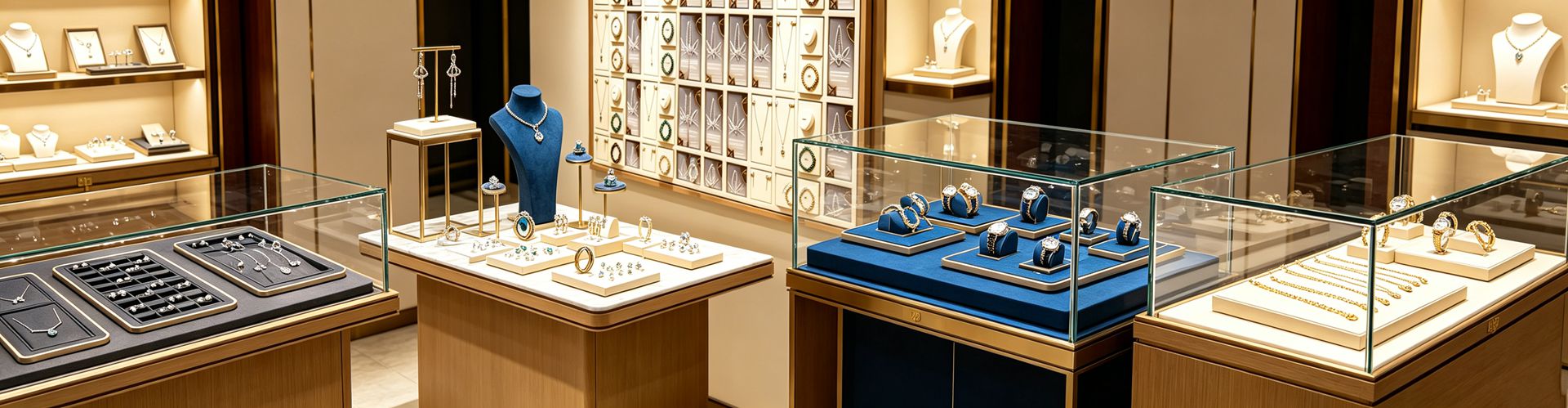
当两枚戒指要"不同却是一对",包装的任务也随之改写。过去一对对戒装在一个双格盒里,靠物理相邻证明关系;现在混金、异宽、异材质的两枚,更常被拆成两只各自成立的首饰盒,再用一处共享设计语言——同款压印、同色内衬、同枚标识——让它们"分开也认得出是一伙的"。这恰恰是深圳骏依美一直在做的事:珠宝盒定制不是把两只盒子做成一模一样,而是为"一对"设计两套能够对话的结构。双格首饰盒要容得下不同宽度的环,开合手感要经得起十年;不透光、可复用的首饰袋,则把"一对"装进同一个移动广告位,成为离店之后沉默的见证。珠宝包装设计在这里,从"保护金子"升级为"封存一段关系"——盒子寿命的标准,也从开箱那一刻好看,延伸到许多年后,两枚戒指还能被一起、体面地打开。
本文为原创内容,版权归深圳骏依美所有,转载请注明出处。
骏依美——让每一件珠宝与腕表,都被更好地呈现。