Material and Colour Do the Talking材质和颜色会说话
Hand a customer the same ring in two different boxes and their sense of what it is worth can shift by close to a third. The jewel did not change. The box did. Six questions we hear constantly from retailers, buyers and brand owners.
Q1: Does box material really change how customers value the piece?
It does, and the judgement lands before the lid opens. Oxford's Crossmodal Research Laboratory found that touch is the single most influential sensory input in luxury assessment, ahead of sight. Its 2023 study showed identical products rated 27% more premium in fabric-wrapped packaging than in rigid paperboard. McKinsey's 2024 luxury retail research is blunter still: 73% of luxury buyers form an opinion about quality from packaging weight and texture alone, within roughly five seconds of holding it. That is why a premium ring box typically weighs 200–320 grams while the ring inside may weigh four. Mass is specified on purpose.
Q2: Velvet, leatherette, paperboard or wood — how should I choose?
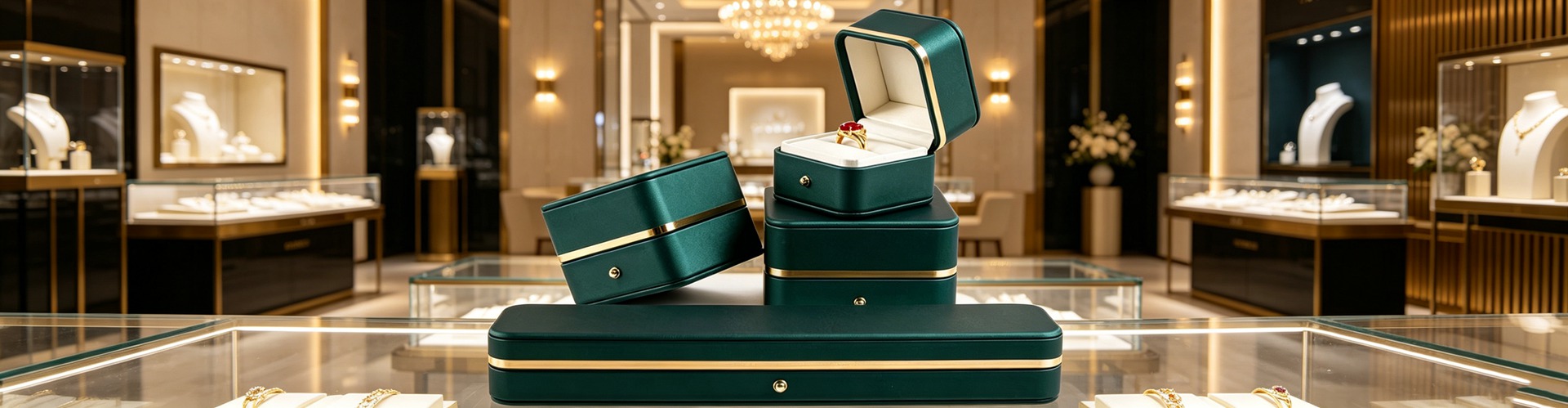
Do not choose by trend. Choose by brand promise. Published unit ranges run roughly: specialty paper $0.40–1.20, soft-touch laminate $0.60–1.50, PU leatherette $1.20–3.50, velvet or silk $2.50–8.00, genuine leather $4.00–12.00. The Luxury Institute's 2024 packaging perception survey tested identical jewellery boxes across finishes: velvet scored 34% higher on perceived product value and 41% higher on giftworthiness than soft-touch laminate — and also scored highest on concern about shipping damage. Velvet carries a hard threshold too. Below a 2mm greyboard substrate it reads cheaper than no fabric at all; 2.5–3mm is where it starts to feel right. Dark velvet shows dust, pale suede shows marks. Approve a production sample, never a render.

Q3: Why does the lining fail more often than the exterior?
Because the exterior gets a glance and the lining gets years. A properly built box is five layers: a 2.0–2.5mm greyboard shell at 850–1000 g/m², the wrap, 8–15mm closed-cell foam die-cut to ±0.5mm, the interior surface that touches the metal, and the hardware. Layer four is the one most programmes skip. Silver darkens through sulphidation (2Ag + H₂S → Ag₂S), and wool felt, rubber and sulphur-inked board all accelerate it. Above 70% relative humidity the reaction can run about ten times faster than in dry air, which is why storage below 50% RH is standard advice. Genuine anti-tarnish lining embeds silver or zinc particles as a sacrificial layer that scavenges sulphur gases — soft to the touch is not the same as protective. Hardware follows the same logic: riveted brass hinges are engineered past 10,000 cycles, while folded-paper hinges fail near 200. A 2022 study in the Journal of Consumer Packaging Research tracked 412 luxury jewellery buyers and found 81% kept the original packaging for more than five years; among those who eventually discarded it, 64% blamed hinge failure or foam compression.
Q4: Is colour really as powerful as people claim?
The numbers outrun intuition. A University of Loyola Maryland study puts the lift in brand recognition from colour at up to 80%. University of Minnesota research found people process visuals roughly 60,000 times faster than text, and colour registers in about 150 milliseconds — ahead of conscious reasoning. A 2023 paper in the Journal of Business Research found packaging colour outweighed shape, size and material in 73% of tested categories. The specifics matter: the Pantone Color Institute reports consumers associate black packaging with prices 20–30% higher than identical items in lighter packaging, while McKinsey's 2024 data shows green-dominant packaging is read as 34% more sustainable even when nothing about the product changed. Colour is not a master key, though. White carries funerary associations across much of East Asia, and black absorbs light in dim retail rooms, where it can simply disappear. Tiffany's blue box is technically specialty paper and a locked Pantone; the hard part is 188 years without drift.
Q5: Do minimal, high-end boxes genuinely win customers over?
They do, provided "minimal" means less volume rather than less structure. Bain's 2025 Global Luxury Market Report found 68% of surveyed luxury brands had introduced or expanded textile-wrapped packaging elements since 2022. Bain and Fedrigoni reported the same year that more than 30% of luxury packaging sales are expected to use sustainable solutions within three years, with reducing packaging weight and volume ranked the top supply-chain sustainability priority among surveyed executives. Packaging of the World's 2024 design awards saw textile-wrapped entries rise 140% over 2021, and judges noted those entries scored highest on desire to keep — the metric that correlates most strongly with brand recall. The real rival of minimal packaging is not ornate packaging. It is packaging that looks like money was saved. Drop the board weight, the closing force or the insert fit, and restraint reads as cheapness within seconds.
Q6: On a tight budget, what gets funded first?
In this order: board thickness, then lining material and fit, then hinges and hardware, then surface decoration. The first three decide whether the box still looks like something after three years; the fourth only decides the first glance. Logistics belongs in the calculation as well. Switching from a pre-assembled rigid hinged box to a flat-pack structure can raise pallet loading by up to 300%, which is a large freight bill you stop paying to ship air. Gift lines and window samples are the exception — there, substance is the point. This is the advice we give most often when clients specify jewellery boxes and pouches: fix the use case and the storage conditions first, then choose material and colour. Shenzhen Junyimei grew up as an export-order jewellery box factory, and we have seen plenty of programmes where the sample stunned the buyer and the hinges died three months into production. Samples are for procurement. Structure is for the customer.
This is original content. Copyright belongs to Shenzhen Junyimei.
Junyimei — present every jewel and timepiece at its best.
同一枚戒指,换两只不同的盒子递给顾客,他们给出的心理估价能差出三成——变的不是珠宝,是盒子的材质和颜色。以下六问,来自门店、采购与品牌方最常纠结之处。
Q1:顾客真的会因为盒子的材质,改变对珠宝本身的判断吗?
会,而且判断发生在开盖之前。牛津大学 Crossmodal 研究实验室的结论是:触觉是奢侈品价值评估中影响最大的单一感官输入,强过视觉。其 2023 年实验显示,同一件商品换成织物包裹的盒子,被评价为"更高端"的程度比硬纸板盒高出 27%。麦肯锡 2024 年奢侈零售研究更直接:73% 的奢侈品买家仅凭包装的重量与手感,在约 5 秒内就完成了对品质的第一次判断。这也是为什么高端戒指盒普遍做到 200–320 克,而里面的戒指可能只有 4 克——分量感是被刻意设计出来的。
Q2:绒布、PU、纸板、木质,到底该怎么选?
别按流行选,按品牌承诺选。行业公开的单只材料成本大致:特种纸 0.4–1.2 美元、软触感覆膜 0.6–1.5 美元、PU 皮 1.2–3.5 美元、绒布或丝绸 2.5–8 美元、真皮 4–12 美元。Luxury Institute 2024 年包装感知调研用同款首饰盒做对照测试,绒布在"感知价值"上比软触感覆膜高 34%、"礼赠感"高 41%,但在"担心运输受损"一项上同样最高。绒布还有一条硬门槛:底板低于 2mm 灰板时,包绒反而比不包更显廉价,2.5–3mm 才立得住。深色绒吸尘、浅色麂皮留痕,下单前务必看量产样而非效果图。
Q3:为什么内衬比外观更容易翻车?
因为外观顾客只看一眼,内衬要陪珠宝好几年。一只合格的盒子是五层结构:2.0–2.5mm、克重 850–1000g/m² 的灰板骨架,外包材,8–15mm 闭孔泡棉(刀模精度 ±0.5mm),直接接触金属的内表面,以及五金。最常被省掉的是第四层。银饰发黑是硫化反应(2Ag + H₂S → Ag₂S),羊毛毡、橡胶、含硫油墨的纸板都会加速它;相对湿度超过 70% 时,反应速度可达干燥环境的约十倍,业内建议存放环境控制在 50%RH 以下。真正的防氧化内衬会在绒面里嵌入银或锌微粒作牺牲层,主动吸走硫化氢,而不只是"摸着软"。五金同理:铆接黄铜铰链可做到一万次以上开合,折纸铰链两百次就开裂。《Journal of Consumer Packaging Research》2022 年追踪 412 位高端珠宝买家,81% 把原包装留了五年以上;而丢掉它的人当中,64% 的原因是铰链坏了或泡棉塌了。
Q4:颜色的影响,真有说的那么大吗?
数据比直觉更夸张。洛约拉大学的研究显示,色彩可将品牌辨识度提升最高 80%;明尼苏达大学的实验表明,人处理视觉信息比处理文字快约 6 万倍,颜色约 150 毫秒内即被大脑处理完毕,先于理性判断;《Journal of Business Research》2023 年的研究发现,在 73% 的受测品类中,包装颜色的权重超过形状、尺寸与材质。具体到色相:Pantone 色彩研究所指出,同样的商品换成黑色包装,消费者会认为它贵 20–30%;麦肯锡 2024 年的数据则显示,绿色主导的包装被认为可持续性高出 34%——哪怕产品本身没变。但颜色不是万能钥匙:白色在东亚有丧葬联想,黑色在照度偏低的店内会"吃光",反而不容易被注意到。蒂芙尼那只蓝盒子的技术含量其实就是特种纸加一个锁死的 Pantone 色号,难的是 188 年不走样。
Q5:高端简约的包装,是不是更容易被顾客青睐?
是,但前提是"简约"指的是减体积,而不是减结构。贝恩 2025 年全球奢侈品市场报告显示,自 2022 年起,68% 的受访奢侈品牌引入或扩大了织物包裹类包装元素;贝恩与 Fedrigoni 的同期报告预计,三年内将有超过 30% 的奢侈品包装销售采用可持续方案,而减重、减容被受访高管列为供应链可持续性的首要优先级。更有意思的是 Packaging of the World 2024 设计奖:织物包裹类参赛作品比 2021 年增加了 140%,评委指出这类作品在"想把盒子留下来"这项指标上得分最高,而它与品牌记忆的相关性最强。简约包装真正的对手不是华丽包装,而是"看起来在省钱"的包装——克重、闭合力、内衬贴合度一旦掉下去,简约会在几秒内被读成简陋。
Q6:预算有限,钱该先花在哪一项?
按这个优先级排:结构板厚 → 内衬材质与贴合 → 铰链五金 → 表面工艺。前三项决定三年后还像不像话,第四项只决定第一眼。渠道成本也要算进来:把预装配的硬盒改成平板式结构,托盘装载量最高可提升约 300%,等于少付一大笔"运空气"的运费;反过来,礼赠线与橱窗样品该厚就得厚。这也是我们在做首饰盒和首饰袋时最常给客户的建议——先定使用场景与存放条件,再定材质和色号。深圳骏依美作为一家从出口订单做起的珠宝盒工厂,见过太多"打样惊艳、量产三个月铰链全坏"的案例:样品是给采购看的,结构是给顾客用的。
本文为原创内容,版权归深圳骏依美所有,转载请注明出处。
骏依美——让每一件珠宝与腕表,都被更好地呈现。