The Diamond Market Splits in Two钻石市场一分为二
A single price board in Shenzhen's Shuibei district has become a portrait of the entire diamond industry. On it, a one-carat high-quality lab-grown loose stone is quoted at 1,800 to 3,500 RMB. In 2020, the same specification sold for around 8,000 RMB. In six years, the number has been halved, then halved again.
Less than a kilometre away, a branded counter still lists a one-carat natural diamond ring at 63,000 RMB, or roughly 53,000 after discount. Same element. Same IGI or GIA certificate. More than a tenfold gap in price.
This is not a pricing error at one store. It is a century-old industry completing a structural split: diamonds are no longer one market. They are two.
The price curve: slowing, but no floor yet
According to the Lab-Grown Diamond Wholesale Price List published by analyst Edahn Golan, global wholesale prices for polished lab-grown diamonds fell 14% year-on-year in the first quarter of 2026. Still painful, but a clear moderation from the 40%-plus declines of the previous year.
The pressure is unevenly distributed. Three-carat rounds dropped 28% year-on-year, the hardest-hit category. Large carats were once the most persuasive selling point of lab-grown stones; they are now where excess capacity piles up fastest. One-carat rounds fell 15%, a gentler slide. Rough is bleeding worse: some lower-grade CVD rough in Dubai and India has been quoted at 20 to 25 US dollars per carat, with sellers shipping at a loss.
One detail deserves attention. Mainstream price lists have removed SI-clarity lab-grown quotations entirely. Producers are subtracting on purpose, concentrating capacity in higher colour and higher clarity goods. Cutting prices and upgrading quality at the same time is the classic posture of an industry clearing itself out.
The divergence: midstream bleeding, retail growing
The genuinely interesting story is the gap between the midstream and the shop floor. In the first quarter of 2026, lab-grown retail volumes grew by double digits while average transaction value stayed broadly flat.
Budgets did not shrink. Buyers simply used the same money to secure bigger carats and better specifications. Falling prices did not produce cheaper purchases; they produced more extravagant ones. A jeweller in Pingzhou, Foshan reported that during Spring Festival 2026, half-carat lab-grown bridal rings accounted for 58% of sales, up 32% year-on-year, while comparable natural-diamond bridal rings fell 19%.
The cost sits in inventory. Tenoris data shows worsening lab-grown stockpiles at US jewellery retailers, with both loose and mounted goods facing slower turnover and rising capital lock-up. Because the midstream leans heavily on memo consignment, the structure amplifies the bullwhip effect. A ripple at retail arrives upstream as a storm.
The other half: natural is moving up
At the high end, natural diamonds have traced almost the opposite curve. In 2026, D-colour IF natural stones above five carats rose 5% year-on-year, and scarce fancy colours kept climbing. A 7.08-carat natural blue sold at Sotheby's this year reached 2.8 million US dollars per carat.
Not everything natural is safe, however. Between 2022 and 2026, melee in the 0.3 to 0.5 carat range lost more than 20% cumulatively. In January 2026, De Beers cut prices on stones above 0.75 carats, its first such move in more than a year.
The dividing line is sharp. Entry-level natural is being substituted; high-end natural is being repriced upward by scarcity. Proven recoverable global reserves sit at roughly 1.7 billion carats, with a static life of under fifteen years and annual output declining 2 to 3%. That supply curve is the one thing a reactor cannot replicate.
NIQ's 2026 Jewellery Gifting Report supports the demand side: 95% of respondents plan to buy jewellery in the next twelve months, and 70% of those favour natural diamonds. Ninety-two percent care about traceability, and 98% say value-added services meaningfully increase purchase intent. In gifting, natural still owns the mental shelf.
The arithmetic in the buyer's head
One consumer's story is typical. She had long wanted a classic 0.3-carat designer diamond necklace priced near 90,000 RMB. An equivalent lab-grown version online cost about 2,700. She chose the latter. Another buyer in Shanghai spent under 10,000 on a lab-grown ring in 2023 and put the remaining 90,000 into gold. Gold has since roughly doubled.
Both decisions follow the same logic: symbolic consumption is yielding to self-directed consumption. And when a retailer promises to buy a stone back at a 40% premium toward an upgrade, the promise itself exposes the weakness — lab-grown resale depends largely on producer buybacks, typically at 30 to 50% of the original price.
The result is stratification, not substitution. A bridal customisation studio in Panyu, Guangzhou reports that packages pairing a lab-grown centre stone with natural melee accents grew 45% year-on-year in 2026. Pragmatism, in ring form.
A third curve: diamonds are leaving jewellery
Viewed only through the jewellery lens, the bigger story goes missing. With room-temperature thermal conductivity of 2,000 to 2,500 W/(m·K) — roughly four to five times copper and eight to ten times aluminium — synthetic diamond is becoming a critical material for AI chip cooling.
The industry calls 2026 the first year of commercial diamond heat-spreader deployment. Guohai Securities projects the global market for chip-grade diamond thermal materials will grow from 37 million US dollars in 2025 to 15.2 billion by 2030, a compound rate above 150%. Since March, several Chinese upstream producers including Zhengzhou Sino-Crystal have issued notices raising large single-crystal rough prices by 15%, citing equipment, raw material and currency costs. With upstream gross margins compressed to around 15%, the era of cheap rough may be nearing its turning point.
Falling prices in jewellery, rising prices in industry. One material, pulled by two incompatible value logics at once.
What it means at retail
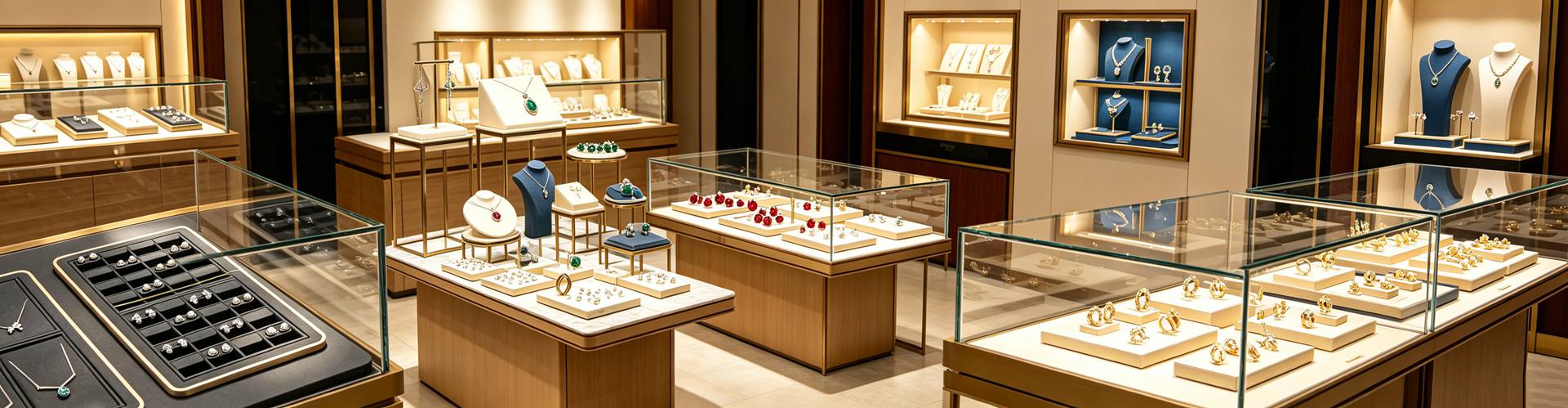
Once the market splits, so must the storytelling. Natural diamonds sell scarcity, traceability and ceremony, which calls for restrained, almost museum-like presentation — lighting, materials, negative space, and a jewelry box that survives a thousand openings. Lab-grown sells design freedom and carat experience, so displays can be brighter, younger and more combinatorial, which puts real pressure on the modularity and refresh cycle of jewelry display props.
Recall that 98% of NIQ respondents said value-added services lift purchase intent. Much of that value lands in the moment of handover. The point of custom jewelry boxes is not expensive material; it is whether the box speaks the same language as the stone inside. An asset-grade natural diamond and a wearable-grade lab-grown stone were never meant to share the same packaging.
As a specialist in jewellery and watch presentation, Shenzhen Junyimei has observed a clear shift: clients used to finalise products first and choose packaging later. Increasingly, brands now plan display and delivery experience alongside the product line itself. The industry has understood that stratification is happening not only in price, but in experience.
Closing
"A diamond is forever" was once a promise about permanence. Today it reads more like a footnote about scarcity. Lab-grown diamonds did not kill natural ones. They simply dug up what half a century of advertising had buried: price comes from scarcity, not from the material itself.
In 2026, half of this market competes on value, the other half on what cannot be reproduced. Knowing which half you stand in matters more than forecasting the price.
This is original content. Copyright belongs to Shenzhen Junyimei.
Junyimei — present every jewel and timepiece at its best.
深圳水贝的一块报价牌,最近成了整个钻石行业的缩影。牌子上,1克拉高品质培育钻石裸石写着"1800—3500元"。而在2020年,同样规格的报价还在8000元上下。六年时间,数字被腰斩再腰斩。
相隔不到一公里的品牌专柜里,一枚1克拉天然钻石戒指标价6.3万元,折后约5.3万元。同一种碳元素,同样的IGI或GIA证书,价格相差十倍以上。
这不是一家店的定价失误,而是一个百年行业正在完成的结构性分裂:钻石不再是一个市场,而是两个。
价格曲线:跌势放缓,但底还没到
行业分析师Edahn Golan发布的《实验室培育钻石批发价格表》显示,2026年第一季度全球培育钻石成品批发价同比下跌14%。数字依旧刺眼,但相较此前一年超过40%的跌幅,已明显收窄。
压力分布并不均匀。3克拉圆形培育钻同比下滑28%——大克拉曾是培育钻最有说服力的卖点,如今也是产能最易堆积之处;1克拉圆形下降15%,相对温和。毛坯端更惨烈,迪拜与印度部分低品级CVD毛坯跌至每克拉20—25美元,已出现亏损出货。
一个易被忽略的细节:主流报价清单已移除SI净度等级的培育钻报价。生产端在主动做减法,降价与提品同时发生,是典型的产业出清姿态。
背离:中游在流血,终端却在增长
真正值得玩味的是中游与零售端的背离。2026年一季度,培育钻终端销量两位数增长,客单价基本平稳。消费者预算没有缩水,他们只是在同样的预算里买到了更大的克拉。降价没有换来"更便宜的成交",而是换来了"更奢侈的体验"。佛山平洲一位珠宝商透露,2026年春节期间0.5克拉培育钻婚戒销量占比达58%,同比增长32%,而同参数天然钻婚戒下滑19%。
代价堆在库存里。Tenoris数据显示,美国珠宝零售门店培育钻库存积压加剧,周转放缓。中游高度依赖寄售模式,这种结构会放大牛鞭效应——终端一点风吹草动,传导到制造端就是一场风暴。
另一半市场:天然钻在往上走
与之几乎完全相反,天然钻石在高端区间保持韧性。2026年5克拉以上D色IF级天然钻价格同比上涨5%,稀缺彩钻持续走高;今年苏富比拍出的一颗7.08克拉天然蓝钻,每克拉成交价达280万美元。
但天然钻也不是全线安全。2022至2026年,0.3—0.5克拉碎钻累计跌幅超20%;2026年1月,戴比尔斯下调0.75克拉以上钻石售价。分界线很清楚:入门级天然钻正在被替代,高端天然钻反而因稀缺被重新定价。全球已探明可采储量约17亿克拉,静态可采年限不足15年,年产量以2%—3%递减——这条供给曲线,是反应炉永远无法复制的。
尼尔森爱科《2026珠宝赠礼调研报告》佐证了这一点:95%受访者计划未来12个月购买珠宝,其中70%首选天然钻石,92%看重可追溯性,98%表示增值服务会显著提升购买意愿。
消费者心里那本账
一位消费者想要某奢侈品牌的经典款0.3克拉钻石项链,售价约9万元;同款造型的培育钻版本约2700元,她选了后者。另一位上海消费者2023年买了一枚不到一万元的培育钻戒,把省下的9万买了黄金——如今黄金差不多翻了一倍。
背后是同一种逻辑:钻石的"符号消费"正在让位于"悦己消费"。而当商家承诺"可加价40%回收换新",反倒暴露了培育钻缺乏二级市场支撑——回收主要依赖生产企业回购,价格仅为售价的30%—50%。用脚投票的结果因此是分层而非替代:广州番禺一家婚戒定制店的数据显示,"培育钻主石+天然碎钻辅石"套餐销量2026年同比增长45%。
第三条曲线:钻石正在离开珠宝行业
只从首饰视角看培育钻,会错过更大的故事。凭借2000—2500 W/(m·K)的室温热导率(约为铜的4—5倍),金刚石正成为AI芯片散热的关键材料。国海证券预测,全球芯片用培育钻石散热市场规模将从2025年的0.37亿美元增至2030年的152亿美元。今年3月以来,郑州华晶金刚石等多家上游厂家发布涨价函,大单晶毛坯统一上调15%。
一边是珠宝端持续降价,一边是工业端逆势涨价。同一种材料,被两条完全不同的价值逻辑同时拉扯。
对零售端意味着什么
市场分成两半,卖场的表达方式也必须分成两套。天然钻卖的是稀缺性与仪式感,需要更克制、更具博物馆气质的呈现——灯光、材质、留白,以及一只经得起反复开合的首饰盒,都是叙事的一部分。培育钻卖的是设计自由与克拉体验,陈列可以更明亮年轻,这对珠宝陈列道具的模块化与更新速度提出更高要求。
别忘了NIQ调研里那98%——增值服务显著提升购买意愿。这部分价值,很大程度落在交付那一刻。珠宝盒定制的意义不在于用了多贵的材料,而在于它是否与这枚钻石的故事同频:资产级的天然钻和佩戴级的培育钻,本就不该被装进同一个盒子。
作为深耕珠宝与腕表呈现方案的服务商,深圳骏依美观察到:过去客户先定产品、再挑包装;现在越来越多品牌在规划产品线时,就把陈列与交付体验一并纳入。分层不只发生在价格上,也发生在体验上。
结语
"钻石恒久远"曾是一句关于永恒的承诺,如今更像关于稀缺的注脚。培育钻石没有杀死天然钻石,它只是把被广告掩盖了半个世纪的事实翻了出来——价格来自稀缺,而非材质本身。2026年的钻石市场,一半在拼性价比,一半在拼不可复制。看清自己站在哪一半,比预测价格更重要。
本文为原创内容,版权归深圳骏依美所有,转载请注明出处。
骏依美——让每一件珠宝与腕表,都被更好地呈现。